Math-Standard
Year 4 Syllabus-- summarised
- 1. Number systems
- 2. Equations
- 3. Functions
- 4. Geometry and Trigonometry
- --> please note the order of this changes often
Rational & Irrational Numbers
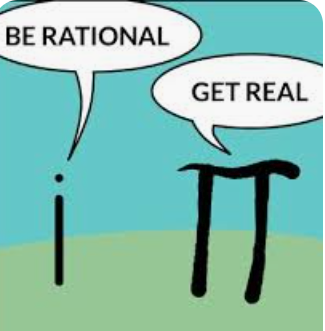
Irrational numbers: A real number that cannot be expressed as a simple fraction (ratio) of two integers. Their decimal expansions are non-terminating and non-repeating. Example: π
Rational numbers: Numbers that can be expressed as a fraction p/q with integers p and q. Their decimals are either terminating or repeating. Example: 69
Practice Task
Write whether the following numbers are rational or irrational:
- π + 3 → If you saaid irrational: correct!
- 4.25 → If you said rational: ding ding ding (correct)
Number System Recap
| Name | Symbol | Properties |
|---|---|---|
| Integer | ℤ | All positive and negative whole numbers |
| Natural | ℕ | Positive integers, counting numbers |
| Real | ℝ | All numbers on the number line |
| Irrational | — | Real numbers that aren’t rational |
| Rational | ℚ | Real numbers that can be expressed in p/q form with a terminating/repeating decimal |
Note: Complex and imaginary numbers exist but we don't need to think about that for now.
In this topic they'll probably also ask about simplification, but that's a topic best learned through practise
-
Combine like terms:
Terms with the same variable and power can be added or subtracted.
Example: 3x + 5x = 8x -
Remove brackets:
Multiply everything inside the bracket.
Example: 2(x + 3) = 2x + 6 -
Cancel common factors:
Divide numerator and denominator by the same value.
Example: 6x / 3 = 2x -
Multiplying powers (same base):
Add the exponents.
Rule: am × an = am+n
Example: x2 × x3 = x5 -
Dividing powers (same base):
Subtract the exponents.
Rule: am ÷ an = am−n
Example: x5 ÷ x2 = x3 -
Power of a power:
Multiply the exponents.
Rule: (am)n = amn
Example: (x2)3 = x6 -
Zero exponent:
Any non-zero base raised to the power 0 equals 1.
Example: x0 = 1
2️⃣ Simplification with Exponents
➗ Simplifying Polynomial Fractions
1️⃣ Factor Everything
Always factor the numerator and denominator completely before simplifying.
Example:
(x² + 5x) / x = (x(x + 5)) / x
2️⃣ Cancel Common Factors
Cancel factors that appear in both the numerator and denominator.
Example:
(x(x + 5)) / x = x + 5 (x ≠ 0)
3️⃣ State Restrictions
The denominator cannot equal zero. Always state any restrictions.
Example:
x ≠ 0
4️⃣ Final Answer
Write the simplified expression and include restrictions if needed.
Note: only cancel factors, not just random terms please
√Radicals
A radical represents the root of a number or expression. General form:
√[n]{a} = x means xⁿ = a
Where:
- a = radicand (number inside the radical)
- n = index (root; 2 = square root, 3 = cube root, etc.)
- x = the number that satisfies the equation
Rules / Properties of Radicals
- Product Rule: √[n]{a·b} = √[n]{a} · √[n]{b}
- Quotient Rule: √[n]{a/b} = √[n]{a} / √[n]{b}, b ≠ 0
- Power Rule: √[n]{a^m} = a^(m/n)
- Simplifying Radicals: √50 = √(25·2) = 5√2
- Even vs Odd Index: Even: radicand ≥ 0; Odd: radicand can be any real number
Worked Examples
- Square root: √16 = 4 (because 4² = 16)
- Cube root: √[3]{-27} = -3 (because (-3)³ = -27)
- Simplifying radicals: √72 = √(36·2) = 6√2
- Using product rule: √(8·2) = √16 = 4 or √8 · √2 = 4
- Using quotient rule: √(81/16) = 9/4
- Using power rule: √[3]{8²} = 8^(2/3) = 4
Sets & Venn Diagrams
What are Sets?
A set is a collection of objects or data grouped together because they share a common property. The objects in a set are called elements.
Sets are often written using curly brackets { } and can contain numbers, letters, or other objects.
What are Venn Diagrams?
A Venn diagram is a visual way to represent sets using circles. It shows how sets are related by displaying:
- Elements that belong to only one set
- Elements shared between sets (intersections)
- Elements that belong to none of the sets (outside the circles)
Venn diagrams make it easier to organise data, compare groups, and solve word problems involving sets.
Example:
Disjoint (Mutually Exclusive) Sets
Disjoint sets (also called mutually exclusive sets) are sets that have no elements in common.
In a Venn diagram, disjoint sets do not overlap at all — they are completely separate.
Interpreting Venn Diagrams (3 Sets)
You will often be asked to interpret survey data using a three-set Venn diagram. The key is to fill in the diagram from the centre outward.
Example Problem
50 students were surveyed about their favourite sport.
- 40 students play at least one sport
- 2 students play all three sports
- 25 play soccer
- 20 play basketball
- 13 play tennis
- 8 play both soccer and basketball
- 3 play both basketball and tennis
Find:
a) How many play only basketball?
b) How many play exactly one sport?
c) How many play both tennis and soccer?
d) How many play exactly two sports?
How to Solve These Problems
-
When a question says “25 play soccer”, this includes:
- Only soccer
- Soccer and basketball
- Soccer and tennis
- All three sports
- To find only a sport, subtract the values in the intersections from the total.
- Start by filling in the centre intersection (students who do all three). Then move outward to regions with two sports, and finally to single-sport regions.
- The given 40 students who play sports represents the universal set. The sum of all regions inside the circles must equal 40.
- Any students not included in the circles are found by subtracting from the total surveyed (50).
Patterns
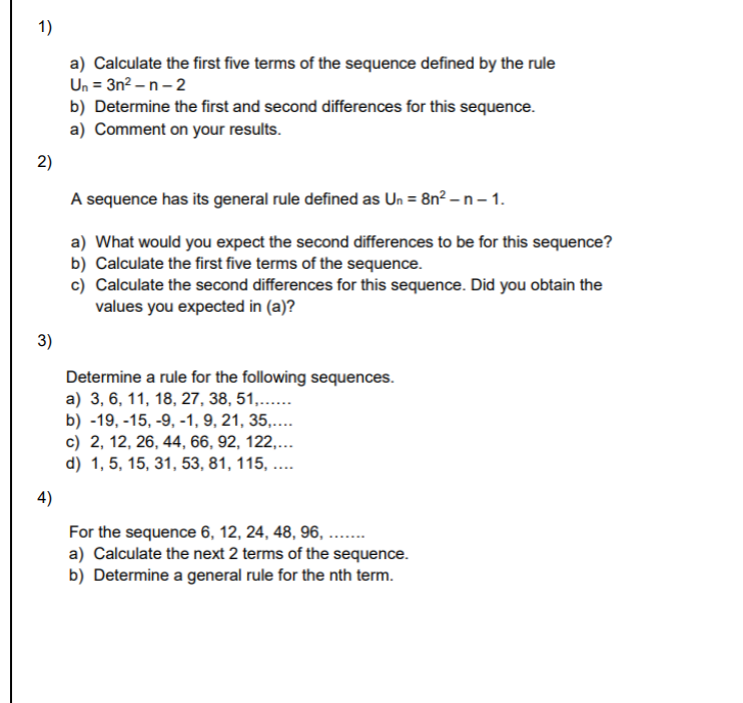
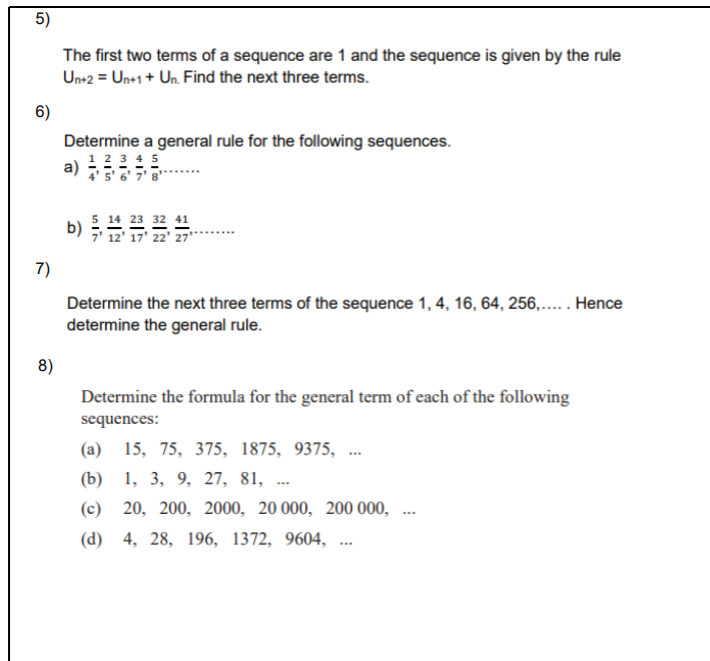
There are three main types of patterns: Arithmetic, Geometric, and Quadratic.
1️⃣ Arithmetic Patterns
If the pattern follows addition or subtraction, it is arithmetic.
Example: 6, 8, 10, 12, 14, 16
The general term (Tn) is given by:
Tn = a + (n - 1)d
- a = first term
- d = common difference
- n = term number
Example calculation:
Tn = 6 + (n-1)·2 = 2n + 4
2️⃣ Geometric Patterns
If the pattern follows multiplication or division, it is geometric.
Example: 2, 4, 8, 16, 32
The general term (Tn) is:
Tn = a · rn-1
- r = common ratio
Example calculation: Tn = 2 · 2n-1
3️⃣ Quadratic Patterns
If a sequence has a constant second difference but inconsistent first difference, it is quadratic.
Example: 1, 4, 9, 16, 25
Second differences:
- 4-1 = 3
- 9-4 = 5
- 16-9 = 7
Formula for quadratic sequences:
Tn = a·n² + b·n + c
a = second difference ÷ 2
Finding b and c
Use the first two terms to create equations:
- n = 1 → T1 = a + b + c
- n = 2 → T2 = 4a + 2b + c
Shortcut to find b:
b = (T2 - T1) - 3a
Then find c:
c = T1 - a - b
Practice – Sequences
Find the general rule for each sequence:
- 5, 18, 35, 56, 81, ...
- 5, 8, 13, 20, 29, ...
- 0, -3, -8, -15, -24, ...
- 5, 10, 19, 32, 49, ...
Command Terms – Criteria B
Describe
Use describe when you need to explain how values change in a sequence or pattern:
- The values in __ increase/decrease by __ each time.
- The values in __ form a quadratic sequence with a constant second common difference of __.
- The values in __ get multiplied/divided by __ each time.
Test
Use test to check if a general rule produces the correct value:
Method: Substituting a given value of n into the general rule.
Example statement: “The value calculated using the general rule is equal to the value given in the table for column __ when n = __.”
Verify
Use verify when you predict a value and check it against the general rule:
Method: Substituting a predicted value of n into the general rule.
Example statement: “The value calculated using the general rule when n = __ is ___.”
Prove / Justify
Use prove/justify when you apply the context of the problem to use an alternative method and explain why the rule works.
Proportionalities
Direct Proportionality
In direct proportionality, as one quantity increases, the other increases proportionally.
The constant of proportionality (k) is given by:
k = y / x
Example:
If 7 kids cost Rs. 140, how much will 12 kids cost?
- k = 140 / 7 = 20
- Cost of 12 kids = 12 × 20 = 240 INR
Indirect Proportionality
In indirect proportionality, as one quantity increases, the other decreases. (e.g., pressure and volume in Boyle’s law)
The constant of proportionality (k) is given by:
k = y × x
Example:
If 4 workers take 6 hours to paint a house, how many hours will 8 workers take?
- k = 4 × 6 = 24
- Hours for 8 workers = 24 / 8 = 3 hours
Exponential Equations
This is solving equations with exponents by using rules of simplification. It is best taught with an example:
16y-1 = 8
Given that 24 is 16 and 23 is 8
=> 24y-4 = 23
This implies that 4y-4 = 3
Therefore 4y = 7
and y = 7/4
25m+1 / 5 = 125
This can be taken as 52m+2 / 5 = 53
Therefore 2m+2 = 3
And 2m = 1
This implies m = ½
Task
Solve the following exponential equations for the unknown variable
49p / 7 = 343
128y-8 / 4 = 256
27h+1 = 9
42k = 32
5r+1 = 252r-3
Answers:
p = 21/2
y = 88/7
h = -1/3
k = 5/4
r = 7/3
Quadratic Equations
They are expressed in the standard form ax2 + bx + c = 0 where a ≠ 0
They can have 2,1 or 0 solutions . There are three methods to solve for these solutions:
Quadratic formula
-b ± √(b² - 4ac)
x = -------------------
2a
√b2-4ac is known as the discriminant. When this is equal to 0, there is one solution, when this > 0 there are 2 solutions and when the discriminant is negative there will be no real solution.
Example Question:
Solve the quadratic equation using the quadratic formula:
2x² + 3x - 2 = 0
Solution:
Step 1: Identify a, b, and c
a = 2
b = 3
c = -2
Step 2: Write the quadratic formula
x = (-b ± √(b² - 4ac)) / (2a)
Step 3: Substitute values
x = (-3 ± √(3² - 4(2)(-2))) / (2(2))
Step 4: Simplify
x = (-3 ± √(9 + 16)) / 4
x = (-3 ± √25) / 4
Step 5: Solve
x = (-3 + 5) / 4 = 2/4 = 1/2
x = (-3 - 5) / 4 = -8/4 = -2
Final Answer:
x = 1/2 or x = -2
Task : Solve for all real solutions of ‘x’ by usage of the quadratic formula
1. x² + 5x + 6 = 0
2. x² - 7x + 10 = 0
3. 2x² + x - 3 = 0
4. 3x² - 2x - 1 = 0
5. x² + 4x = 12
Answers:
1. x = -2 or x = -3
2. x = 5 or x = 2
3. x = 1 or x = -3/2
4. x = 1 or x = -1/3
5. x = 2 or x = -6
Null factor law
The null factor law states that if ab = 0, then a = 0 or b = 0.
Example Question:
Solve the quadratic equation using the null factor law:
(x + 4)(x - 3) = 0
Solution:
Step 1: Apply the null factor law
If ab = 0, then a = 0 or b = 0
Step 2: Set each factor equal to zero
x + 4 = 0 or x - 3 = 0
Step 3: Solve each equation
x = -4
x = 3
Final Answer:
x = -4 or x = 3
Task: Solve for ‘y’ using the null factor law
Hint: Factorise the ones given in standard form.
- (y + 2)(y - 5) = 0
- y² - y - 12 = 0
- 2y² + 7y + 3 = 0
- (y - 6)(y + 1) = 0
- 3y² - 10y - 8 = 0
Answers:
- y = -2 or y = 5
- y = 4 or y = -3
- y = -3 or y = -1/2
- y = 6 or y = -1
- y = 4 or y = -2/3
Completing the Square Method
Completing the square is a method used to solve quadratic equations or rewrite them into a perfect square form.
The goal is to turn part of the expression into this form:
(x + a)²
Example Question:
Solve x² + 6x + 5 = 0 by completing the square
Step 1: Move the constant to the other side
x² + 6x = -5
Step 2: Take half of the coefficient of x, then square it
Coefficient of x = 6
Half of 6 = 3
Square it: 3² = 9
Step 3: Add this number to BOTH sides
x² + 6x + 9 = -5 + 9
x² + 6x + 9 = 4
Step 4: Rewrite the left side as a perfect square
(x + 3)² = 4
Step 5: Square root both sides
x + 3 = ±2
Step 6: Solve for x
x + 3 = 2 or x + 3 = -2
x = -1 or x = -5
Final Answer:
x = -1 or x = -5
Task: Solve for x by completing the square
- x² + 4x + 3 = 0
- x² + 8x + 7 = 0
- x² - 6x + 5 = 0
- x² + 10x + 16 = 0
- x² - 4x - 5 = 0
Answers:
- x = -1 or x = -3
- x = -1 or x = -7
- x = 1 or x = 5
- x = -2 or x = -8
- x = 5 or x = -1
Example Question (word problem)
In a flight of 600 km an aircraft was slowed down due to bad weather. Its average speed for the trip was reduced by 200 km/h and the time increased by 30 minutes. Find the flight's duration.
Step 1: Define the variable
Let the original speed of the aircraft be v km/h.
Distance = 600 km
Time = Distance ÷ Speed
Step 2: Write expressions for time
Original time = 600 / v
New speed = v - 200
New time = 600 / (v - 200)
The time increased by 30 minutes.
30 minutes = 0.5 hours
Step 3: Form the equation
New time = Original time + 0.5
600 / (v - 200) = 600 / v + 0.5
Step 4: Multiply everything by v(v - 200) to remove fractions
600v = 600(v - 200) + 0.5v(v - 200)
Step 5: Expand
600v = 600v - 120000 + 0.5v² - 100v
Step 6: Simplify
Move everything to one side:
0 = 0.5v² - 100v - 120000
Multiply everything by 2 to remove decimals:
0 = v² - 200v - 240000
Step 7: Solve the quadratic
v² - 200v - 240000 = 0
Factorise:
(v - 600)(v + 400) = 0
Step 8: Solve
v = 600 or v = -400
Speed cannot be negative, so:
v = 600 km/h
Step 9: Find the original duration
Original time = 600 / 600
Original time = 1 hour
Final Answer:
The flight's original duration was 1 hour.
The new duration is 1.5 hours.
Question:
A train travels 480 km between two cities. Due to track maintenance, its average speed was reduced by 20 km/h, which increased the travel time by 1 hour.
Find the train's original speed.
→ You may solve this using any method of choosing
Linear Inequalities
Example: Solve for ‘x’
2x - 5 ≥ 5x - 7
⇒ 2x - 5x ≥ -7 + 5
⇒ -3x ≥ -2
⇒ x ≤ -2 / -3 (flip the inequality when the coefficient of ‘x’ is negative)
⇒ x ≤ ⅔
This can also be represented in set builder form:
{x | x ≤ ⅔ , x ∈ ℝ }
Questions:
- -2(x - 3) < 5(x + 1) - 12
- (-3x + 1) / 2 ≤ 11
- 3x + 8 < -2(x - 1) + 5
Answers:
- x > 13/7
- x ≥ -7
- x < -1/5
→ Note that this won’t give an exact value for ‘x’ never say x = whatever in an inequality
Word Problem (Linear Inequalities)
Lucy has $17 to spend on a taxi ride. The taxi charges $5 per mile.
(a) Write and solve a linear inequality to find the maximum number of miles Lucy can travel.
(b) Lucy had to spend $5 on baby oil, and her friends took $6 and ran. How many miles can she travel now?
(c) Lucy’s home is 10 miles away, will she be able to get home through the taxi?
Compound/Double Inequalities
You solve this the same way, except there are two inequalities instead of one. When ‘or’ is used to describe the inequalities’ relationship, it indicates a union and when ‘and’ is used to describe their relationship it indicates an intersection.
Task: Solve each double inequality.
- x + 3 ≥ 7 and x + 3 ≤ 15
- 2x - 4 > 6 and 2x - 4 < 16
- x/2 - 1 ≥ 3 and x/2 - 1 ≤ 9
- 3x + 5 ≤ 2 or 3x + 5 ≥ 14
- x - 8 < -2 or x - 8 > 10
Answers:
1. x + 3 ≥ 7 and x + 3 ≤ 15
x ≥ 4 and x ≤ 12
2. 2x - 4 > 6 and 2x - 4 < 16
2x > 10 and 2x < 20
x > 5 and x < 10
3. x/2 - 1 ≥ 3 and x/2 - 1 ≤ 9
x/2 ≥ 4 and x/2 ≤ 10
x ≥ 8 and x ≤ 20
4. 3x + 5 ≤ 2 or 3x + 5 ≥ 14
3x ≤ -3 or 3x ≥ 9
x ≤ -1 or x ≥ 3
5. x - 8 < -2 or x - 8 > 10
x < 6 or x > 18
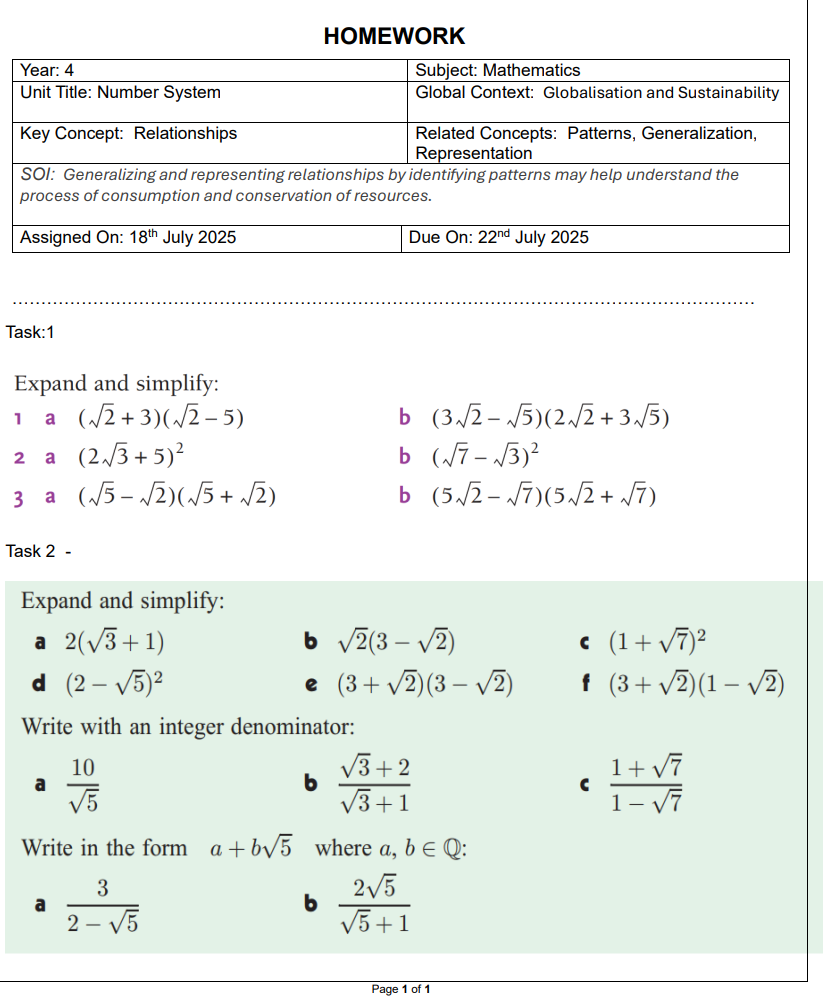
Rationalizing the Denominator of a Fraction with a Surd
Single-term denominator: Multiply both numerator and denominator by the same surd. The denominator becomes a whole number since a surd squared is rational.
Multiple-term denominator: Multiply numerator and denominator by the conjugate of the denominator (swap the ± sign). This removes the surd because multiplying by itself would still leave a surd term.
Linear Programming
Linear programming is used to find the optimal solution to linear functions or inequalities. It helps determine maximum or minimum values in problems like profit optimization.
Key concept: Identify all inequalities, graph the feasible region, and check the corner (extreme) points for the optimum value.
Simultaneous Equations
3x + 2y = 4
4x + 5y = 17
There are two methods to solve these equations, elimination method and substitution method. Elimination method is preferred but it's lowkey ur choice (or is it?)
Elimination method
Given:
3x + 2y = 4
4x + 5y = 17
Multiply the first equation by 4 and the second equation by -3:
12x + 8y = 16
-12x - 15y = -51
Add the equations:
-7y = -35
Solve for y:
y = -35 / -7
y = 5
We can input this into the first equation:
3x + 2(5) = 4
3x + 10 = 4
3x = -6
x = -2
Final Answer:
x = -2
y = 5
Substitution method
Given:
3x + 2y = 4 ...(1)
4x + 5y = 17 ...(2)
Step 1: Rearrange the first equation to make x the subject
3x + 2y = 4
3x = 4 - 2y
x = (4 - 2y) / 3
Step 2: Substitute this into the second equation
4x + 5y = 17
4((4 - 2y) / 3) + 5y = 17
Step 3: Simplify
(16 - 8y) / 3 + 5y = 17
Multiply everything by 3:
16 - 8y + 15y = 51
16 + 7y = 51
Step 4: Solve for y
7y = 35
y = 5
Step 5: Substitute y = 5 into x = (4 - 2y) / 3
x = (4 - 10) / 3
x = -6 / 3
x = -2
Final Answer:
x = -2
y = 5
Word Problem:
You're stalking someone to try stealing from them. You notice they withdraw ₹9000 from an ATM using only ₹500 notes and ₹200 notes.
Let x be the number of ₹500 notes and y be the number of ₹200 notes.
(a) Write a simultaneous equation representing this situation.
(b) If the total number of notes withdrawn was 24, find how many ₹500 notes and how many ₹200 notes were withdrawn.
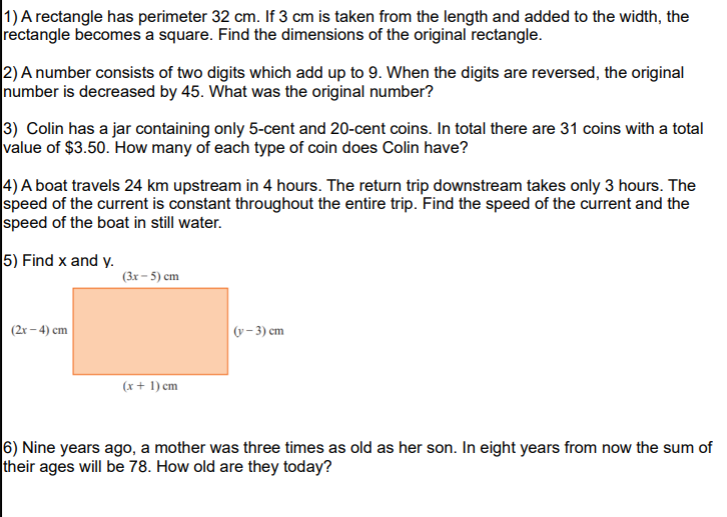
Here’s some practise on simultaneous equations:

Mixed Questions (Past Summative Paper)
Survey Question
In a survey, 100 students were asked if they like Basketball (B), Football (F) and Swimming (S). The results were as follows:
- 17 students liked all three sports.
- 3 students did not like any of these.
- 42 students liked Basketball and Football.
- 29 students liked Basketball and Swimming.
- 57 students liked Football.
- 40 students liked Swimming.
- 74 students liked Basketball.
a) Represent the given information in the Venn diagram and find the value of x.
b) Find the number of students who liked exactly one sport.
c) Find the number of students who liked Football or Basketball.
Answer:
x = 3
40 students liked exactly one sport
89 students like either football or basketball
Find the value of x.
Answer: x = ⅙
Inverse Proportionality Question
Mili has decided to encourage her class to participate in ‘Adopt a Sumatran Tiger’ which funds research and conservation of these critically endangered animals. The cost of adoption per person depends on the number of people participating.
a) Verify that the number of people and the cost per person are inversely proportional.
b) Find the constant of proportionality and write down the equation connecting the number of people and the cost per person.
c) Calculate the cost per person when 25 people participate.
Answers:
a) Yes, it is inversely proportional as the number of people increases the cost decreases at a constant rate.
b) k = 100
c) C = 12
Splitting The Middle Term
This uses a technique known as the “Master Product” method to “split” the middle term into two terms, so that the trinomial can be factorized into two binomials.
ax² + bx + c
- Multiply a and c; their product will be the “master product”.
- Find a pair of factors of the master product that, when added, equal the b coefficient.
- Split the b coefficient into two terms with the coefficients being the factor pair.
- Factorize the expression.
Changing The Subject
Simply shift the terms in an equation around till the desired term is expressed as a multiple of other terms.
Functions
A function is a relationship between inputs and outputs where one input can only be assigned one output.
Quadratic Functions
Quadratic functions are similar to quadratic equations. When plotted, they form a parabola shape on a graph.
- The y-coordinate of the highest or lowest point in the parabola is the vertex of the quadratic function, or the maximum/minimum value.
- The x-coordinate of the highest or lowest point is the axis of symmetry of the quadratic function. The parabola can be divided into two symmetrical halves around this line.
- The points where the parabola cuts the x-axis are the x-intercepts. There are always two solutions, but they may not always exist for real values.
- The point where the parabola cuts the y-axis is the y-intercept. It may not always exist depending on the function.
Forms of Quadratic Functions
Standard Form:
f(x) = ax² + bx + c
- f(x) = any y-coordinate
- x = corresponding x-coordinate
Vertex Form
The vertex form of a quadratic function is:
f(x) = a(x-h)² + k
- f(x) = any y-coordinate
- x = corresponding x-coordinate
- a = the same a as in standard form
- h = x-coordinate of the vertex
- k = y-coordinate of the vertex
Intercept Form
The intercept form of a quadratic function is:
f(x) = a(x-p)(x-q)
- f(x) = any y-coordinate
- x = corresponding x-coordinate
- a = the same a as in standard form
- p = first x-intercept
- q = second x-intercept
Quadratic Equations
Quadratic equations are polynomial expressions with at least one squared term. They do not include terms raised to powers higher than two.
They can be written as:
ax² + bx + c = 0
- a and b are coefficients of x, with a ≠ 0
- c is a constant
Quadratic equations are set equal to 0 to simplify solving, allowing us to focus on values that make the product of the binomial terms equal to 0. Any value on the right side can be moved to the left, keeping the equation equal to 0.
To solve for x, the quadratic formula is used:
x = [-b ± √(b² - 4ac)] / 2a
Note: If a problem asks for “infinite solutions,” it means that, when simplified, the first equation equals the second. The lines overlap entirely, so any solution satisfies both.
Completing the Square
Completing the square is a method used to factorize quadratic equations by rewriting them as the sum of a squared binomial plus a constant.
Reference: mathsisfun.com
Gradients
The gradient of a line measures its slope, showing both steepness and direction.
It is calculated using the formula:
Gradient = rise / run = (y₂ - y₁) / (x₂ - x₁)
- Rise = difference between any two y-coordinates on the line
- Run = difference between the corresponding x-coordinates
An equation of a line expresses the relationship between all y-coordinates and their corresponding x-coordinates.
Exponential Growth and Decay
Exponential growth and decay describe quantities that increase or decrease at extremely rapid rates, such as populations or radioactive substances.
The formula for both is:
f(t) = a(1 ± r)t
- a = initial amount
- t = time elapsed since the initial amount
- r = rate of change (as a decimal)
Depending on whether the quantity is growing or decaying, r is added to or subtracted from 1:
- Growth: (1 + r)
- Decay: (1 - r)