UNIT 1 - WHY DO SOCIETIES EXPERIENCE REVOLUTION?
1. What Is a Revolution?
A revolution is a major and often sudden change that attempts to transform a society, region, or country. They disrupt existing systems of power and bring long-term political, social, or economic change.
Key Characteristics
- Transformative: Fundamental changes to structures.
- Fast-moving: Usually occurs within a few years.
- Driven by people: Motivated by hope and idealism.
- Conflict-filled: Involves confrontation and violence.
- Unique: Shaped by specific historical and cultural contexts.
2. Why Do Societies Experience Revolution?
Historians identify four major factors:
- Dissident Elites: Influential groups proposing alternatives to the system.
- Mass Frustration: Poverty, inequality, or oppression of ordinary people.
- Shared Motivation: A common goal that unifies the public.
- State Crises: Failing governments, economic collapse, or military defeats.
3. Types of Revolutions
- Political: Overthrowing a government.
- Social: Seeking rights and equality.
- Technological: Changes in work and production.
- Cultural: Changing values and identity.
- Religious: Changing the role of religion in governance.
THE RUSSIAN REVOLUTION
4. Russia Before 1914
Ruled by Tsar Nicholas II, an autocratic ruler. The empire was multi-ethnic and religious, but the Tsar exercised strict control through censorship and secret police.
5. Social and Economic Conditions
- Peasantry: 85% of the population, living in poverty under the Mir system.
- Industrial Workers: Poor working conditions and low wages.
6. Growth of Socialism
- Socialist Revolutionary Party: Represented peasant interests.
- Bolsheviks: Led by Vladimir Lenin.
7. 1905: The "Bloody Sunday" Revolution
On 22 January 1905, thousands of peaceful protesters, led by Father Gapon, marched to the Winter Palace in St. Petersburg to present a petition to Tsar Nicholas II. They demanded better working conditions, fair wages, and political reforms.
Troops opened fire on the crowd without warning, killing and wounding hundreds of men, women, and children. This event became known as “Bloody Sunday” and sparked widespread outrage across Russia.
- Workers went on strike, peasants revolted, and unrest spread throughout the empire.
- It exposed the Tsar’s inability to address social and political issues.
- In response to the unrest, Tsar Nicholas II reluctantly created the Duma (a national parliament) in October 1905, as a concession to the people.
- However, the Tsar retained significant powers, and the Duma had limited influence.
Significance: Bloody Sunday marked the beginning of revolutionary movements in Russia, showing that peaceful protests could escalate into nationwide crisis and challenging the Tsar’s authority.
8. 1917: February and October Revolutions
- February Revolution: In March 1917 (February in the old Russian calendar), widespread strikes, protests, and riots erupted in Petrograd due to food shortages, poor working conditions, and the ongoing First World War. Soldiers eventually sided with the protestors. The unrest forced Tsar Nicholas II to abdicate, ending over 300 years of Romanov rule.
- A Provisional Government was formed to temporarily run the country. It promised reforms and democratic elections but struggled to address key issues like war, land, and workers’ rights.
-
October Revolution: In November 1917 (October in the old calendar), the Bolsheviks, led by Vladimir Lenin, seized power from the Provisional Government.
They promised “Peace, Bread, and Land” to gain popular support:
- Peace: Withdraw from WWI immediately.
- Bread: End food shortages for workers and peasants.
- Land: Redistribute land from landlords to peasants.
- The Bolsheviks’ takeover marked the start of Communist rule in Russia and led to the Russian Civil War between the Red (Bolshevik) and White (anti-Bolshevik) forces.
Significance: The February and October revolutions ended centuries of monarchy, transferred power to a socialist government, and set the stage for the formation of the Soviet Union.
9. Key Personalities
| Name | Significance |
|---|---|
| Nicholas II | Last Tsar of Russia |
| Vladimir Lenin | Leader of the Bolsheviks |
| Leon Trotsky | Military leader in Civil War |
| Grigory Rasputin | Influential mystic |
Grigori Rasputin
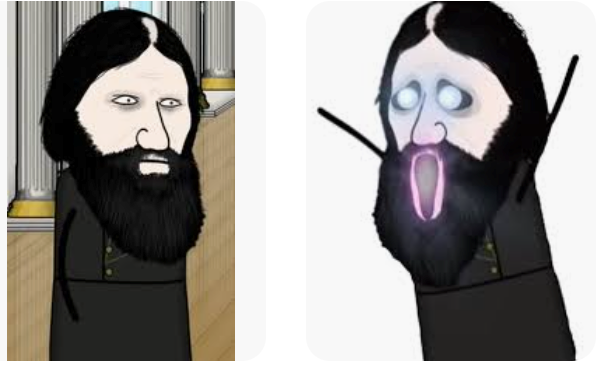
Grigori Rasputin (1869–1916)
Who was Rasputin?
Grigori Rasputin was a Russian mystic, self-proclaimed holy man, and advisor to Tsar Nicholas II and Tsarina Alexandra during the final years of Imperial Russia.
Connection to the Royal Family
- The Tsar and Tsarina’s son, Alexei, suffered from haemophilia
- Rasputin appeared to ease Alexei’s symptoms through prayer and calming influence
- This caused the Tsarina to believe Rasputin was chosen by God
Influence on Government
- Advised the Tsarina during World War I when the Tsar left to lead the army
- Influenced appointments of ministers and officials
- Many appointments were ineffective or corrupt
Public Image and Controversy
- Known for heavy drinking and immoral behaviour
- Rumours of sexual relationships and corruption spread widely
- Seen as a symbol of government decay
Assassination of Rasputin (1916)
- Murdered by a group of nobles led by Prince Felix Yusupov
- They believed killing Rasputin would save the monarchy
- His death failed to stop the collapse of Tsarist rule
Historical Significance
- Weakened public confidence in Tsar Nicholas II
- Exposed the instability and isolation of the royal family
- Contributed indirectly to revolutionary anger
OPVL Analysis
Understanding OPVL
Step One – OPVL: Origin, Purpose, Value, Limitation
Origin, Purpose, Value and Limitation (OPVL) is a technique for analyzing historical documents. It is used extensively in the International Baccalaureate curriculum and assessments and is highly effective in developing critical historical thinking. OPVL is closely related to Document Based Questions (DBQs).
Origin
In order to analyze a source, you must first identify what it is. Not all origin questions can always be answered, but the more you know about where a document comes from, the easier it becomes to determine its purpose, value, and limitations.
The distinction between primary and secondary sources can be complex, as historians often debate how certain documents should be classified.
Primary Sources
Letters, journals, interviews, speeches, photographs, paintings, and other firsthand materials. These are created by individuals directly involved in events and present original perspectives. They are not filtered through later interpretation.
Secondary Sources
Materials written with hindsight that interpret or evaluate primary sources, such as history textbooks or scholarly analyses. Political cartoons can sometimes function as either primary or secondary sources depending on context.
Note: One type is not inherently more reliable than the other. Both provide valuable historical evidence.
Key Origin Questions
- Who created the document?
- When was it created and published?
- Where was it produced?
- Who published it?
- What do we know about the author that is relevant?
Purpose
Purpose focuses on why the document exists. You must think from the author’s perspective and evaluate the document as a standalone piece.
- Why was this document created?
- What was the author’s intent?
- Why was this format chosen?
- Who was the intended audience?
- What does the document explicitly state?
- What can be inferred beyond the surface meaning?
Avoid phrases like “I think”. Instead, write: “The document suggests… because this is supported by…”
Value
This is where you evaluate the document as a historian. Based on the origin and purpose, determine what value the document has as historical evidence.
- What does it reveal about the author?
- What does it show about the time period?
- What circumstances influenced its creation?
- Does it represent a particular perspective or side?
- What historical context does it accurately reflect?
Example of Value Analysis:
The journal entry written by President Truman before the atomic bombing of Japan demonstrates his moral dilemma and awareness of diplomatic, military, and humanitarian consequences.
Limitation
Limitations identify where the document ceases to be useful for historians—not simply its flaws.
- What parts of the story are missing?
- Whose perspectives are excluded?
- How could this source be verified?
- Does it inaccurately represent any aspect of the time period?
- What does the author deliberately avoid discussing?
Bias does not automatically limit a source’s value. If discussing bias, explain who the source favors or excludes and why.
Step Two – OPVL Format for Assessments
| Category | Guiding Questions |
|---|---|
| Origin | When, where, and by whom was it produced? |
| Purpose | What was the intended audience and intent? |
| Value | What makes this document useful to historians? |
| Limitation | What can this document not tell us? |
OPVL Rubric
| Category | A | B | C | D–F |
|---|---|---|---|---|
| Origin | Strong and extensive understanding | Clear understanding | Some understanding | No understanding |
| Purpose | Strong understanding of author, context, and intent | Some understanding | Limited understanding | No understanding |
| Value | Two or more accurate, relevant insights | Somewhat accurate insights | Limited or inaccurate insights | Missing or incorrect |
| Limitation | Two or more accurate, relevant insights | Somewhat accurate insights | Limited or inaccurate insights | Missing or incorrect |
UNIT 2 - NATURAL HAZARDS AND EARTH PROCESSES
1. Theory of Continental Drift
Proposed by Alfred Wegener, stating all continents were once part of Pangaea.
Evidence
- Jigsaw Fit: South America and Africa.
- Fossils: Mesosaurus found on separate continents.
- Botanical: Glossopteris fossils.
2. Plate Tectonics
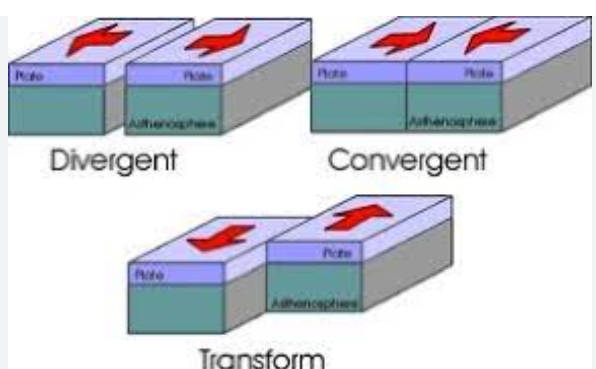
The lithosphere is divided into plates floating on the asthenosphere.
- Divergent: Plates move apart.
- Convergent: Plates collide.
- Transform: Plates slide past.
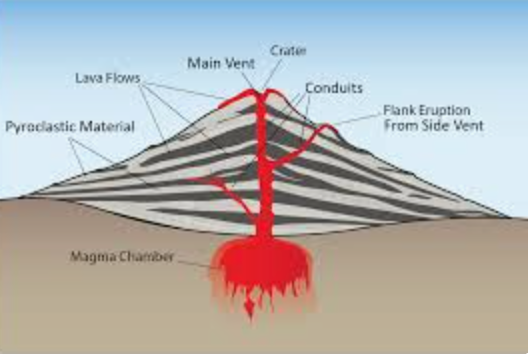
3. Volcanoes
An opening where magma escapes as lava.
-
Active
- A volcano that is currently erupting or has erupted in recent history
- Shows signs of activity such as earthquakes, gas emissions, or lava flow
- Likely to erupt again in the future
- Example: Mount Etna (Italy)
-
Dormant
- A volcano that has not erupted for a long period of time
- Appears inactive but still has the potential to erupt again
- May show minor underground activity
- Example: Mount Fuji (Japan)
-
Extinct
- A volcano that is not expected to erupt again
- Its magma supply has been cut off
- No signs of volcanic activity
- Example: Arthur’s Seat (Scotland)
4. Tsunami
A tsunami is a series of large ocean waves caused by sudden displacement of water, usually linked to plate tectonic activity.
Connection to Plate Tectonics
- Most tsunamis occur at convergent (destructive) plate boundaries
- Subduction zones cause powerful undersea earthquakes
- The sudden movement of the sea floor displaces large volumes of water
Connection to Volcanoes
- Underwater volcanic eruptions can displace water suddenly
- Volcanic island collapses or landslides can trigger tsunamis
- Explosive eruptions may cause shock waves in surrounding water
Wave Behaviour
- Deep water: Waves travel very fast with low height and are often unnoticed
- Coastal areas: Waves slow down, increase in height, and become destructive
5. Mountain Building (Orogenesis)
Orogenesis is the process by which mountains are formed due to plate tectonic movements, especially at plate boundaries.
1. Folding (Fold Mountains)
- Occurs at convergent plate boundaries where two plates move towards each other
- When two continental plates collide, neither sinks easily
- Instead, layers of rock are compressed, bent, and folded upwards
- This creates long mountain chains known as fold mountains
Link to Volcanoes
- When collision is continent–continent, volcanoes are rare
- However, if an oceanic plate is involved, subduction can occur
- Subduction causes melting, leading to magma rise and volcanic mountain chains
2. Faulting (Fault-Block Mountains)
- Occurs due to tensional or compressional forces within the Earth’s crust
- Large blocks of crust break along fault lines
- Some blocks are pushed up (horsts) while others sink (grabens)
- This forms fault-block mountains
Link to Volcanic Mountains
- Faults create weak zones in the crust
- Magma can rise through these cracks
- This can result in volcanic mountains forming alongside fault systems
6. Earthquakes
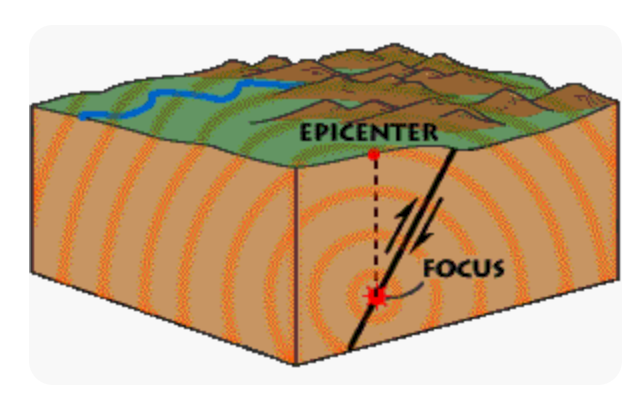
An earthquake is the sudden release of energy in the Earth’s crust, caused by the movement of tectonic plates along faults.
Diagram showing the hypocentre (focus) and epicentre
Connection to Plate Tectonics
- Earthquakes occur mainly at plate boundaries
- Tectonic plates are constantly moving but often get stuck due to friction
- Stress builds up as plates try to move past each other
- When the stress exceeds the strength of rocks, it is released suddenly as an earthquake
Types of Plate Boundaries and Earthquakes
- Convergent boundaries: Powerful earthquakes due to subduction or collision
- Transform boundaries: Shallow but destructive earthquakes (plates slide past)
- Divergent boundaries: Frequent but weaker earthquakes as plates move apart
Key Terms
-
Hypocentre (Focus):
- The point inside the Earth where the earthquake starts
- Located along a fault line within the crust
- Energy is released from this point in the form of seismic waves
-
Epicentre:
- The point on the Earth’s surface directly above the hypocentre
- Usually experiences the strongest shaking
- Damage is often greatest near the epicentre
Link to Volcanoes
- Earthquakes often occur near volcanic regions
- Magma movement beneath volcanoes can cause small earthquakes
- At subduction zones, earthquakes and volcanoes often occur together
Richter Scale
| Magnitude | Category |
|---|---|
| Up to 4.9 | Slight |
| 5.0 – 6.9 | Moderate |
| 7.0 – 7.9 | High |
| 8.0+ | Catastrophic |
7. Disaster Mitigation
Disaster mitigation refers to measures taken to reduce the impact, damage, and loss of life caused by natural hazards. These strategies are especially important in areas affected by plate tectonic activity.
Types of Mitigation (IB Classification)
1. Short-Term Mitigation
- Actions taken immediately before or during a hazard
- Aim to reduce loss of life
- Examples:
- Evacuation orders
- Emergency shelters
- Public warning alerts
2. Long-Term Mitigation
- Planned over many years
- Aim to reduce future risk and damage
- Examples:
- Land-use planning
- Building regulations
- Education programs
3. Structural Mitigation
- Involves physical structures
- Designed to withstand or control hazards
- Earthquakes:
- Earthquake-resistant buildings
- Flexible foundations and shock absorbers
- Volcanoes:
- Lava diversion channels
- Reinforced roofs to withstand ash fall
- Tsunamis:
- Seawalls and coastal barriers
- Raised buildings near coastlines
4. Non-Structural Mitigation
- Does not involve buildings or engineering
- Focuses on planning, awareness, and policy
- Earthquakes:
- Building codes and safety laws
- Public earthquake drills
- Volcanoes:
- Hazard maps showing danger zones
- Restrictions on settlement near volcanoes
- Tsunamis:
- Coastal evacuation plans
- Public education on warning signs
5. Monitoring and Prediction
- Uses technology to detect warning signs
- Allows time for evacuation
- Examples:
- Seismometers for earthquakes
- Gas sensors and ground deformation for volcanoes
- Ocean buoys to detect tsunami waves
6. Preparedness
- Ensures people know how to respond during a disaster
- Reduces panic and confusion
- Examples:
- Emergency kits
- School evacuation drills
- Clear emergency communication systems
UNIT 3 - HOW SOCIETIES ARE GOVERNED?
1. Democracy
The word democracy comes from the Greek words Demos (people) and Kracy (power), meaning "rule by the people." It is a form of government where representatives are elected, and the government rules with the consent of the people.
"Democracy is a government of the people, by the people, and for the people." — Abraham Lincoln
1. Democracy
Democracy is a system of government in which power ultimately rests with the people. Citizens either participate directly or elect representatives to make decisions on their behalf.
Key Features of Democracy
- Popular Sovereignty: Final decision-making power lies with elected representatives.
- Free and Fair Elections: Elections are held regularly, and the ruling party can lose power.
- Political Equality: One person, one vote, one value.
- Rule of Law: Government works within constitutional limits.
- Protection of Rights: Freedom of speech, expression, religion, and assembly are guaranteed.
- Accountability: Leaders can be questioned, criticized, and removed through elections.
Merits and Demerits of Democracy
| Merits (Advantages) | Demerits (Disadvantages) |
|---|---|
| Encourages citizen participation and political awareness. | Majority may dominate or suppress minority groups. |
| Guarantees civil liberties and individual freedoms. | Decision-making can be slow due to debates and procedures. |
| Allows peaceful change of government. | Elections can be expensive and encourage corruption or populism. |
| Government can correct mistakes through feedback. | Ill-informed voters may choose ineffective leaders. |
2. Monarchy
A monarchy is a system of government where the head of state is a monarch (king, queen, emperor), usually ruling for life and inheriting power through family lineage.
Types of Monarchy
- Absolute Monarchy: The monarch holds complete power (e.g., Saudi Arabia).
- Constitutional Monarchy: The monarch’s powers are limited by a constitution and an elected government (e.g., United Kingdom).
Merits and Demerits of Monarchy
-
Merits:
- Provides political stability and continuity.
- Quick decision-making during emergencies.
- Symbol of national unity in constitutional monarchies.
-
Demerits:
- Lack of public participation in governance.
- Risk of incompetent rulers due to hereditary succession.
- Can reinforce class inequality and privilege.
3. Dictatorship
A dictatorship is a system of government where power is held by one person or a small group, often obtained through force, military takeover, or manipulation. The ruler is not accountable to the public.
Key Characteristics of Dictatorship
- No free or fair elections.
- Opposition parties are banned or suppressed.
- Media is controlled or censored.
- Power is maintained through fear, propaganda, or force.
Merits and Demerits of Dictatorship
-
Merits:
- Fast decision-making and implementation of policies.
- Political stability in the short term.
- Ability to enforce strict reforms.
-
Demerits:
- Severe restriction of freedoms and human rights.
- No accountability or transparency.
- No clear succession plan, leading to instability.
- Often results in abuse of power.
4. Difference Between Monarchy and Dictatorship
| Aspect | Monarchy | Dictatorship |
|---|---|---|
| Source of Power | Hereditary (family line) | Force, military, or manipulation |
| Legitimacy | Cultural and historical acceptance | Fear, propaganda, and coercion |
| Succession | Predefined heir | Uncertain and often violent |
| Public Participation | Limited or symbolic | None |
UNIT 4 – WHAT IS CULTURE?
1. Cultural Heritage
Cultural heritage refers to the legacy of physical artefacts and non-physical traditions, values, and practices that are passed down from one generation to the next within a society. It represents how people understand their past and how that past continues to influence their identity today.
Culture is not something that is fixed or frozen in time. Instead, it is dynamic — it changes as societies evolve, adapt, and respond to new ideas, technologies, and interactions with other cultures. Cultural heritage helps preserve continuity while still allowing change.
Cultural heritage plays a key role in shaping a group’s:
- Beliefs and values
- Traditions and customs
- Ways of thinking and behaving
- Sense of belonging and identity
It helps individuals understand who they are and where they come from. Through shared cultural heritage, communities develop a collective memory that connects past, present, and future generations.
Cultural heritage also influences how societies interact with the world. It affects language, social norms, celebrations, decision-making, and responses to change. When cultural heritage is lost or damaged, communities may experience a loss of identity and historical connection.
Understanding cultural heritage encourages respect for diversity and helps people recognize that different societies may have different ways of living, thinking, and expressing meaning, all of which are equally valid.
Tangible Cultural Heritage
Tangible cultural heritage refers to physical, material objects that can be seen, touched, and preserved. These objects are created by humans and provide visible evidence of how societies lived, believed, governed, and expressed creativity in the past.
Tangible heritage reflects a society’s level of technology, artistic skills, religious beliefs, social organisation, and interaction with the environment. Many tangible heritage sites are protected because they offer historical evidence that cannot be replaced once destroyed.
- Examples: Paintings, sculptures, monuments, temples, churches, mosques, forts, palaces, manuscripts, tools, and archaeological sites.
These physical remains help historians and geographers reconstruct the past. However, tangible cultural heritage is vulnerable to threats such as urbanisation, war, natural disasters, pollution, and neglect.
Intangible Cultural Heritage
Intangible cultural heritage refers to non-physical aspects of culture that communities recognise as part of their identity. Unlike tangible heritage, it cannot be stored in museums alone — it exists through practice, performance, and transmission between people.
Intangible heritage is described as “living heritage” because it is continuously recreated and adapted as societies change. It strengthens social bonds and helps communities maintain continuity in a rapidly globalising world.
- Examples: Oral traditions (storytelling, legends), performing arts (dance, music), rituals, festivals, traditional knowledge, and traditional craftsmanship.
The survival of intangible cultural heritage depends on people actively practising and teaching it. When younger generations stop learning these traditions, they risk disappearing entirely.
2. UNESCO and Preservation
UNESCO plays a major role in protecting cultural heritage across the world. The 2003 UNESCO Convention for the Safeguarding of Intangible Cultural Heritage formally recognised that culture is not only monuments and objects, but also living traditions.
The convention aims to:
- Safeguard endangered cultural practices
- Respect cultural diversity
- Raise awareness of intangible heritage at local and global levels
- Support sustainable development through culture
UNESCO also promotes the idea of “Living Human Treasures” — individuals who possess exceptional cultural knowledge or skills. These individuals play a vital role in passing traditions to future generations through teaching and practice.
Preservation does not mean freezing culture in the past; instead, it supports communities in continuing their traditions in meaningful and relevant ways.
3. Multicultural Society
A multicultural society is one in which people from different cultural backgrounds — including different ethnicities, religions, languages, and traditions — live together within the same society.
In a multicultural society, cultural diversity is recognised and, ideally, respected. Individuals are encouraged to retain their cultural identity while participating in shared social, political, and economic systems.
Multicultural societies can benefit from:
- Cultural exchange and innovation
- Broader worldviews and tolerance
- Economic and social creativity
However, they can also face challenges such as cultural misunderstanding, discrimination, and unequal access to opportunities. Effective policies, education, and dialogue are essential to ensure peaceful coexistence.
- Characteristics: Acceptance of different groups, shared cultural practices, and recognition of minority histories.
- Statistical Fact: A 2018 Pew Research Center study showed that people aged 6–21 form the most culturally diverse generation in American history.
4. Global Examples of Multiculturalism
Multiculturalism exists in many countries due to historical migration, economic opportunities, colonial links, and globalisation. Governments may actively support multiculturalism through laws, policies, and public services.
-
Argentina:
Argentina has a long history of immigration, particularly from Europe during the 19th and
early 20th centuries. Its constitution actively supports immigration, recognising the role
migrants played in shaping the nation’s economy and culture.
Cultural diversity is reflected in:- Multilingual media available in English, German, Italian, French, and Spanish
- European architectural styles in cities such as Buenos Aires
- Food, music, and traditions influenced by Italian and Spanish heritage
-
Canada:
Canada is one of the most well-known examples of an officially multicultural country.
In the 1970s, it became the first nation to adopt multiculturalism as an official
government policy.
Key features include:- Legal protection for cultural expression
- Support for cultural festivals and language preservation
- High levels of immigration, with over 200,000 immigrants from more than 26 ethnocultural groups arriving each year
This policy aims to promote equality, reduce discrimination, and encourage social cohesion while allowing people to maintain their cultural identities.
5. Importance of Diversity
Cultural diversity is increasingly important in a globalised world where societies are more interconnected than ever before. The 2001 UNESCO Universal Declaration on Cultural Diversity states:
"Cultural diversity is as necessary for humankind as biodiversity is for nature."
This statement highlights that just as ecosystems rely on biological diversity to survive, human societies rely on cultural diversity for resilience, creativity, and long-term development.
- Builds trust and mutual respect: Exposure to different cultures encourages understanding, tolerance, and cooperation between groups, reducing prejudice and conflict.
- Encourages innovation: Diverse perspectives lead to new ideas in science, technology, business, art, and governance. Societies with cultural diversity often experience higher levels of creativity and problem-solving.
- Helps adaptation in a globalised world: Cultural diversity allows societies to respond more effectively to global challenges such as migration, climate change, and economic shifts by drawing on a wide range of knowledge systems and experiences.