English
Purpose of Language
Language is a powerful tool used by humans to communicate ideas, thoughts, feelings, and information. It shapes understanding and influences relationships, culture, and society.
- To inform: Giving factual or educational content to increase knowledge or understanding.
- Examples: news reports, textbooks, scientific journals, manuals.
- Key features: clear structure, precise vocabulary, factual evidence, diagrams.
- To entertain: Amusing, engaging, or emotionally moving the audience.
- Examples: stories, novels, poems, plays, cartoons.
- Key features: narrative techniques, descriptive language, humour, suspense, rhyme or rhythm.
- To persuade: Convincing someone to think, feel, or act in a certain way.
- Examples: speeches, advertisements, opinion articles, debates.
- Key features: rhetorical questions, emotive language, repetition, statistics, call-to-action.
Additional purposes:
- To instruct: Step-by-step guides, recipes, manuals, showing how to do something.
- To describe: Giving detailed accounts of settings, characters, or processes (common in narratives and reports).
- To express feelings or opinions: Letters, diaries, blogs, poetry.
Types of Texts
Texts can be broadly divided into two main categories:
- Literary texts: Creative texts intended to entertain, explore human experiences, or provoke thought.
- Stories, novels, short stories, plays, poetry, fables, myths.
- Features: plot, characters, setting, narrative voice, figurative language (simile, metaphor, personification), themes.
- Non-literary texts: Informational or practical texts created to convey factual or functional information.
- Examples: articles, reports, letters, posters, advertisements, emails, instructions, pamphlets.
- Features: headings, subheadings, bullet points, factual tone, images or diagrams, statistics.
Other classifications:
- Print texts: Books, newspapers, posters, magazines.
- Digital texts: Websites, blogs, emails, social media posts.
- Oral texts: Speeches, debates, conversations, storytelling.
- Multimodal texts: Combine two or more modes (visual, audio, written) like videos, infographics, animations.
Text features to analyse:
- Structure: Introduction, body, conclusion.
- Language: Formality, tone, sentence types, vocabulary.
- Visuals: Diagrams, illustrations, charts, typography.
- Purpose: Why was it created, and how does it achieve its goal?
Audience and Context
Understanding the audience and context is essential for interpreting a text effectively.
- Audience: Who the text is intended for.
- Age group, cultural background, interests, education level.
- Influences language choice, tone, and complexity.
- Context: The situation in which the text is created.
- Time period, location, social, political, or cultural factors.
- Impacts style, examples, and references used.
- Tone and formality: Reflects the writer’s attitude and relationship with the audience.
- Formal: academic, professional, objective.
- Informal: conversational, personal, subjective.
- Mode of communication: Written, oral, visual, digital, or multimodal.
Rhetorical devices and techniques to consider:
- Repetition – emphasises key ideas.
- Emotive language – appeals to feelings.
- Statistics and facts – adds credibility.
- Rhetorical questions – engages audience.
- Imagery and descriptive language – paints vivid pictures.
Communication Skills
Effective communication combines clarity, structure, and empathy.
- Verbal communication: Speaking clearly, using appropriate vocabulary, tone, and volume.
- Non-verbal communication: Body language, gestures, facial expressions, eye contact, posture.
- Written communication: Organisation, clarity, grammar, punctuation, style, and coherence.
- Listening skills: Active listening, summarising, questioning, clarifying.
- Digital communication: Emails, chats, social media posts – clarity and etiquette are crucial.
Techniques for improvement:
- Practice summarising texts in your own words.
- Engage in discussions and debates.
- Peer feedback and reflection.
- Analyse model texts for structure and language use.
Barriers to Communication
Understanding barriers helps improve clarity and reduce misunderstandings.
- Physical barriers – noise, distance, environmental distractions.
- Psychological barriers – stress, emotions, assumptions, bias.
- Language barriers – unfamiliar words, jargon, accents, or dialects.
- Technological barriers – poor connectivity, misused platforms.
- Cultural barriers – differences in norms, beliefs, and values.
Evaluating Texts
Critical reading and analysis help determine purpose, effectiveness, and reliability.
- Identify author and credibility.
- Analyse structure, language, and tone.
- Check for bias or opinion vs. fact.
- Evaluate evidence: statistics, examples, anecdotes.
- Consider audience response and impact.
Tips: Annotate, summarise key points, highlight examples and techniques, and ask why each element is used.
Modes of Communication
- Written: Books, letters, articles, essays, reports.
- Oral: Speeches, presentations, debates, interviews.
- Visual: Posters, infographics, charts, videos.
- Multimodal: Combines two or more modes, e.g., video presentations with captions and graphics.
writing sentences
Sentences are necessary to written communication. There really is no better way to share your point of view other than with a fantastically well-written sentence. Learning how to use language correctly and identifying parts of a sentence will help you to do this.
Task 1
In pairs, identify why each of the following is not an accurate sentence:
- The boy pushed his bike slowly into the garage, upset by the damage the car had caused.
- Apples for £1.99 a kilo.
- Rode home.
- Valeria told that she liked San José.
- He wants to go but his mother won't agree.
- After the summer.
- The sun on my facе.
- Walked up the hill.
Understanding sentences
A sentence in English must include a verb.
A phrase is a group of words without a verb.
A clause is a group of words with a verb. A main clause is a clause which has meaning on its own and could be a sentence.
television
Did you know that it was the inventions and discoveries of many different scientists that resulted in giving us television?
The 'first' generation of television sets were very different from what we have now and were not entirely electronic. The TV screen had a small motor with a spinning disc and a neon lamp, which worked together to give a blurry reddish-orange image about five centimetres wide. The period before 1935 is called the 'Mechanical Television Era'.
Visit this website: www.tvhistory.tv/pre-1935.htm and research scientists who invented the television. I know you may be thinking this isn't important for english but iB loves connecting subjects as I'll show below
Links to: History
The first experiments with television broadcasting were conducted in the 1920s and 1930s in Great Britain and the United States.
In 1936 the British Broadcasting Corporation (BBC) started the world's first television broadcast and in America the first programme was broadcast in 1941.
Use a search engine, such as Google, to carry out your research.
Graph to narrow down your search. Another useful tool is InstaGro, a search engine that generates a web of related videos, images articles, and terms based on a specific query. You can also use instaGrok to evaluate sources.
Create a timeline representing the evolution of TV and TV broadcasting in your country.
Links to: Sciences
Did you know that it was the inventions and discoveries of many different scientists that resulted in giving us television?
The 'first' generation of television sets were very different from what we have now and were not entirely electronic.
The TV screen had a small motor with a spinning disc and a neon lamp, which worked together to give a blurry reddish-orange image about five centimetres wide.
The period before 1935 is called the 'Mechanical Television Era'. Visit this website: www.tvhistory.tv/pre-1935.htm and research the scientists who invented the television.
Is language changing in film and television?
We do not remember learning how to speak, but learning to write is an ongoing process that involves learning to use language correctly and practising in order to become a good writer. In fact, humans were able to speak one hundred thousand years ago, but it was not until much later that we felt the need to represent sounds graphically in order to keep them, and thus writing was born.
ACTIVITY: How did writing evolve?
ATL Information literacy skills: Collect, record and verify data
Written language is not always represented in the same way. Find out about the following writing systems and summarize the information you find on:
- pictographic writing
- alphabetic writing
- ideographic script.
You could speak to students in your class who use different alphabetical systems or ideographic languages.
Assessment opportunities
In this activity you have practised skills that are assessed using Criterion C: Producing text and Criterion D: Using language.
Register is an important feature of both spoken and written language. It refers to the tone, style, word choice and degree of formality of language. Whether speaking or writing, it is essential to use the register that is most appropriate to your audience and purpose.
Standard English is appropriate to all formal situations, as well as many informal situations. At other times, you need to consider the purpose of the text, the audience and the effect you want to achieve in writing or speaking.
Oral and written language are two different systems that we use in various communication processes. Oral communication includes conversations, television debates, TV and radio interviews. Written communication includes letters, novels and newspaper articles.
Standard English
Standard English is the style of English language (grammar, vocabulary and spelling) that is widely accepted in spoken and written form. Standard English is used to communicate in formal and some informal contexts. It is considered the appropriate choice of style in media writing and TV and radio news announcements.
Colloquial language is informal language, and there may be variations in words or phrases used that are specific to a geographical area or region.
Slang is very informal language. It is creative language, and it is usually linked to the world of music and fashion. Slang is related to the language young people use, and every generation creates their own slang words and phrases. It's tough to keep up with the latest modern words!
Use a search engine to find out about the different styles of language and write down some examples for each style. How does register affect each style?
Received Pronunciation and BBC English
Is there such a thing as BBC English? What is Received Pronunciation?
The BBC is the British Broadcasting Corporation, the world's oldest broadcasting organization. It used to be the case that presenters on the BBC spoke in a certain way. These days, broadcasters tend to speak with a broader range of accents.
Before the Second World War, in the early days of television, radio announcers and newsreaders did speak with Received Pronunciation or RP, as it is also known. RP was more common in the southern part of England, and it is linked to a social class rather than 'a particular type of English'. It is sometimes also referred to as the Queen's English.
Search Received Pronunciation and listen to some old broadcasts to hear what it sounds like.
The BBC should represent the diversity of the British Isles - the variety of accents and dialects found across the United Kingdom should be reflected in the voices that are heard on programmes such as the news.
Fiction
Fiction texts tell imagined or creative stories that explore characters, events, and ideas.
- Plot: The sequence of events that make up the story.
- Exposition: Introduces setting, characters, and context.
- Rising action: Builds tension or conflict.
- Climax: Turning point or most intense moment.
- Falling action: Consequences of the climax.
- Resolution/denouement: Conflict resolved, story concludes.
- Setting: Where and when the story takes place.
- Time: Historical period, season, or era.
- Place: Physical locations and social environment.
- Atmosphere/mood: Created through descriptive language and tone.
- Characters: People, animals, or beings in the story.
- Protagonist: Main character who drives the story.
- Antagonist: Character or force opposing the protagonist.
- Supporting characters: Add depth and context to the plot.
- Characterisation methods: Direct description, dialogue, actions, thoughts, and how others perceive them.
- Theme: Central idea, message, or moral of the story.
- Common examples: Friendship, love, courage, injustice, perseverance.
- How to identify: Look for recurring motifs, conflicts, or moral dilemmas.
- Narrative Perspective:
- First-person: Told from “I”, offers personal insight.
- Third-person limited: Focused on one character’s perspective.
- Third-person omniscient: Narrator knows all characters’ thoughts and feelings.
Non-Fiction
Non-fiction texts provide factual or informative content and aim to explain, inform, or persuade the reader.
- Main ideas: The essential points or messages the text communicates.
- Supporting details: Evidence, examples, explanations, or anecdotes that reinforce main ideas.
- Facts vs Opinions: Facts are verifiable statements; opinions are subjective beliefs or interpretations.
- Text features: Headings, subheadings, bullet points, images, charts, and captions to guide understanding.
- Author’s purpose: Why the text was written (to inform, persuade, or entertain).
- Bias and reliability: Check sources, evidence, and potential author perspective.
Literary Devices
Literary devices enhance meaning, create mood, and engage the reader.
- Simile: Comparison using “like” or “as” (e.g., “Her smile was like the sun”).
- Metaphor: Direct comparison without using “like” or “as” (e.g., “Time is a thief”).
- Personification: Giving human traits to objects or animals (e.g., “The wind whispered”).
- Imagery: Language appealing to senses: visual, auditory, tactile, gustatory, olfactory.
- Alliteration: Repetition of consonant sounds to create rhythm (e.g., “She sells seashells”).
- Onomatopoeia: Words that imitate sounds (e.g., “buzz”, “clang”).
- Symbolism: Objects, characters, or actions representing larger ideas.
- Irony: Contradiction between expectation and reality (verbal, situational, dramatic).
- Foreshadowing: Clues hinting at future events.
Making Inferences
Inference is the skill of understanding information that is implied but not directly stated, by using clues from the text.
- Look for context clues in descriptions, dialogue, or actions.
- Analyse word choice and tone to understand implied meaning.
- Consider the narrator’s perspective and biases.
- Use background knowledge to interpret unstated ideas.
- Support inferences with textual evidence, including quotes or page references.
Evaluating Texts Critically
- Analyse purpose: Why was it written? Who is it for?
- Check credibility: Author, sources, and reliability of information.
- Identify techniques: Literary devices, tone, structure, evidence use.
- Assess effectiveness: Does it achieve its purpose? How does it affect the audience?
- Consider context: Historical, social, cultural, and political factors that shape the text.
Comparing Texts
- Identify similarities and differences in theme, style, tone, or purpose.
- Analyse how different authors approach similar topics.
- Compare narrative perspectives and characterisation.
- Look at use of literary or rhetorical devices in each text.
- Consider audience and context differences.
Developing Analytical Responses
- Plan responses: identify main ideas, themes, and evidence.
- Use textual evidence to support claims or interpretations.
- Explain the effect of language and structure on meaning.
- Link analysis to context, audience, and purpose.
- Use clear paragraphs and logical sequencing for written responses.
Oral texts
Oral texts are everywhere. We can explore the way culture and identity are reflected in our use of language and how our language changes with changes in society and technology. We can analyse spoken texts in the same way that we can analyse written texts.
The context ofa spoken text is important as there are no genres in spoken language. To analyse spoken language you must consider the elements below:
12
Accent
The way in which words and letters are pronounced. Accent can vary according to the region or social class of the speaker.
Context
The circumstances in which the communication takes place. This impacts greatly on the speech exchange. Speakers change their language according to the listeners and the situation.
Dialect
The grammar and vocabulary used and linked to a particular region.
Emphasis or stress
Words can be emphasized by being said louder or slower.
Intonation
This is essential to communication and is linked to how we say things, rather than what we say. It affects the meaning we give to words and phrases.
Filler
These are used in speech to fill a pause, usually to provide thinking time. For example: er, erm, like.
Interruption
When someone does not wait for the speaker to finish what they are saying and takes over the topic.
Jargon
Technical and specialized vocabulary related to the topic being discussed.
Overlapping
Two speakers talk at the same time, usually out of support and agreement with one another.
Pauses
Breaks in speech, sometimes filled (with fillers). Can be used for a range of reasons, such as thinking time, hesitation, indicating they want the other person(s) to contribute.
Turn-taking
The people in the conversation take it in conventional and polite turns to speak.
Narrative Writing
Narrative writing tells a story, real or imagined, with a clear sequence of events and engaging characters.
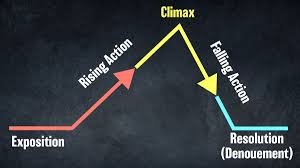
- Exposition: Introduces characters, setting, and context.
- Who is involved? Describe key traits and relationships.
- Where and when is the story set? Use vivid sensory details.
- Hint at the main conflict to create interest.
- Rising Action: Events that develop the story and build tension.
- Introduce obstacles or challenges faced by characters.
- Develop character motivations and relationships.
- Use dialogue and action to show emotions and conflict.
- Climax: The turning point or most intense moment.
- The main conflict reaches its peak.
- Decisions made here affect the outcome.
- Often includes suspense, surprises, or dramatic tension.
- Falling Action: Events following the climax leading toward resolution.
- Consequences of the climax unfold.
- Loose ends and secondary conflicts begin to resolve.
- Characters reflect or react to the climax.
- Resolution: The conclusion where conflicts are resolved.
- Shows the final outcome for characters and setting.
- Leaves a lasting impression or moral for the reader.
- Can hint at future events if part of a series.
3.2 Descriptive Writing
Descriptive writing focuses on creating vivid pictures in the reader’s mind using detailed sensory information.
- Senses to include: Sight, sound, touch, taste, smell.
- Use figurative language: Similes, metaphors, personification to enhance imagery.
- Focus on details: Describe one moment, object, or character at a time for maximum effect.
- Organise logically: Spatial order, chronological order, or by importance.
- Tone and mood: Word choice influences how the reader feels.
3.3 Informative / Expository Writing
Informative writing explains ideas, concepts, or processes clearly and logically.
- Purpose: To inform, educate, or explain using facts, data, or examples.
- Structure: Introduction (topic statement), Body (facts, evidence, examples), Conclusion (summary, reflection).
- Clarity and precision: Avoid vague language; use technical terms where appropriate.
- Evidence-based: Use facts, statistics, examples, or diagrams to support points.
- Transitions: Connect ideas logically (first, next, moreover, finally).
- Language style: Formal, neutral, and objective tone.
Persuasive / Argumentative Writing
Persuasive writing aims to convince the reader to accept a point of view or take action.
- Purpose: Influence opinions or encourage specific actions.
- Structure: Introduction (state opinion), Body (arguments and evidence), Conclusion (reinforce viewpoint).
- Use of evidence: Facts, statistics, examples, expert opinions, anecdotes.
- Persuasive techniques:
- Rhetorical questions
- Repetition for emphasis
- Emotive language
- Contrast and comparison
- Direct address to the reader
- Counterarguments: Acknowledge opposing views and refute them with evidence.
- Tone and style: Confident, assertive, yet respectful.
Parts of Speech
Words are classified according to their function in a sentence. Understanding them helps with clarity, variety, and accuracy in writing.
- Nouns: Names of people, places, things, or ideas.
- Common nouns: dog, city, school
- Proper nouns: Rosa, Mumbai, Eiffel Tower
- Abstract nouns: freedom, happiness
- Pronouns: Replace nouns to avoid repetition. Examples: he, she, it, they, who.
- Verbs: Express actions or states.
- Action verbs: run, write, think
- Linking verbs: is, are, seem
- Adjectives: Describe nouns or pronouns. Example: tall, beautiful, mysterious.
- Adverbs: Describe verbs, adjectives, or other adverbs. Example: quickly, very, silently.
- Prepositions: Show relationships between nouns/pronouns and other words. Example: in, on, under, between.
- Conjunctions: Connect words, phrases, or clauses. Examples: and, but, although, because.
- Interjections: Express strong emotions. Examples: wow!, oh no!, hurray!
Sentence Structure
Sentences can be classified by their complexity. Using varied structures improves readability and style.
- Simple sentences: One independent clause. Example: “The sun rises.”
- Compound sentences: Two or more independent clauses joined by a conjunction. Example: “The sun rises, and the birds start singing.”
- Complex sentences: One independent clause and at least one dependent clause. Example: “Although the sun rises, it is still cold in the morning.”
- Compound-complex sentences: Combination of compound and complex sentences. Example: “Although it was raining, I went outside, and I met my friend.”
Tenses
Tenses show the time of an action. Correct tense usage ensures clarity and consistency in writing.
- Present: Happening now or habitual actions. Examples: “I write daily.” / “She plays football.”
- Past: Happened before now. Examples: “I wrote yesterday.” / “They played football last week.”
- Future: Will happen later. Examples: “I will write tomorrow.” / “She will play football next week.”
- Perfect tenses: Show completed actions relative to another time. Examples:
- Present perfect: “I have written the essay.”
- Past perfect: “I had finished before the bell rang.”
- Future perfect: “By tomorrow, I will have finished.”
- Continuous / Progressive tenses: Emphasize ongoing actions. Examples: “I am writing.” / “She was playing football.” / “They will be traveling.”
Media Texts
Media texts are created to inform, entertain, or persuade. They include both print and digital forms.
- Advertisements: Promote products or ideas; often use persuasive language, slogans, and images.
- Posters: Visual texts combining images and words to convey a clear message quickly.
- Digital articles and blogs: Online content aimed at informing or entertaining readers.
- Videos and social media: Combine audio, visuals, and text for engagement.
Analyzing Media Texts:
- Identify the purpose of the text.
- Recognize target audience and appeal methods.
- Examine language, tone, and style.
- Analyze visual elements like color, layout, and images.
Purpose, Bias, and Visual Literacy
Understanding the purpose and potential bias in media helps interpret messages critically.
- Purpose: Inform, persuade, entertain, or educate.
- Bias: Favoring one viewpoint over another; may be intentional or unintentional.
- Visual literacy: Ability to interpret images, symbols, and layout to understand meaning.
- Media techniques: Use of color, composition, font, and imagery to influence perception.
Literary and Rhetorical Devices in Media
Media often uses literary devices to make content engaging, persuasive, or memorable.
- Alliteration: Repeating initial sounds for emphasis (e.g., “Fresh, Fast, Fantastic!”).
- Hyperbole: Exaggeration to grab attention (e.g., “The best phone ever!”).
- Metaphor: Direct comparison to create impact (e.g., “Time is money”).
- Simile: Comparison using “like” or “as” (e.g., “As smooth as silk”).
- Personification: Giving human qualities to objects (e.g., “The car roared to life”).
- Repetition: Repeating words or phrases for effect (e.g., slogans).
- Rhetorical questions: Questions that provoke thought rather than require an answer.
- Emotive language: Words designed to evoke feelings (e.g., “heartbreaking,” “amazing”).
- Symbolism: Using symbols to represent ideas or themes.
- Irony: Saying the opposite of what is meant for effect.
Critical Analysis and Evaluation
To fully understand media texts, apply critical thinking to evaluate credibility, reliability, and effectiveness.
- Check for accuracy of facts and sources.
- Look for persuasive techniques and appeals (ethos, pathos, logos).
- Consider multiple perspectives and missing information.
- Evaluate whether the message is biased or objective.
- Reflect on your own response and interpretation of the text.
The purposes of different text types
When we set out to write, it is important that we make the right choices about the genre and purpose of our texts. We need to identify clearly what we want to achieve, in other words, what message we hope to convey, and then decide which text type or genre is the most suitable for transmitting this message to its audience.
Look at the information on the right to help you understand which texts types are best suited for which purpose.
What are you really good at doing? Do you have any skills which others envy? Perhaps you know how to make the perfect peanut butter and jam sandwich or you know how to make a paper aeroplane. This is your opportunity to share your expertise with others.
Create a mind map of some of the things you do welland select one thing.
Write a set of instructions explaining how to do it.
Expository text
Information is collected and synthesized. The text is objective; reports are the most common type of expository text.
For example, giving directions, sequencing steps, comparing one thing to another, explaining causes and effects, or describing problems and solutions belong to the expository genre.
- Autobiographies
- Directions
- Essays
- Instructions
- Posters
- Recipes
- Reports
- Summaries
Narrative text
The text retells familiar stories and/ or creates original stories. Narrative texts have a beginning, middle and end to develop the plot and characters.
.
이
- Original short stories
- Personal narratives
- Retellings of stories
- Sequels to stories
- Story scripts
Text Analysis- PAFT and PEEL
Writing an Introduction
This isn't too important but all you've gotta do is:
- Introduce the text (title, author, text type)
- Give some context (what the text is about)
- Lead into your main argument
Thesis Statement
The thesis statement is the most important sentence in your introduction.Like actually this is the only important part, a good thesis takes your analysis from a level 5 to level 6. To write it you present what you're gonna analyse and the main argument you'll take Every paragraph should atleast somewhat connect back to this idea.
Writing a thesis statement:
level 1- this is a garbage thesis you will get no marks if you write it: In the speech he comments on questions such as "what happened before the big-bang" and "is there other life in the universe" simplifying what has stumped great minds for years. However by uses inspiring tones hawking shifts the purpose of the speech from solely being an informatory paragraph to serving as an inspiration to audiences globally, inspiration to continuosly seek knowledge about our universe. Stephen hawking quotes "I have been very lucky that my disability has not been a serious handicap. Indeed, it has probably given me more time than most people to pursue the quest for knowledge", this is a motivatory factor, persuading all including those who appear "disabled" to aspire towards greater heights of knowledge
level 2- this is a better thesis that will get marks: "Green shopping will not save the planet" by journalist Heather Rogers is likely aimed towards all audiences. This is because the text does not involve any mature topics or profane language. It is very well written and easy to follow along, through clear lines such as "let me be clear, there is nothing wrong with the standard reduce, reuse, recycle" providing a message on how to actually positively impact the environment "Some sacrifice for the sake of our planet- i tell you all!"- a morale which is necessary and prefered for all ages.
Some key things to remember when writing a theses are to divide it from the introduction with a small subheading and giving justifications for your argument early on
PEEL Structure (Body Paragraphs)
Use PEEL to structure each paragraph clearly:
- P – Point: State your main idea (linked to the thesis)
- E – Evidence: Provide a quote or example from the text
- E – Explain: Explain how the evidence supports your point
- L – Link: Link back to the thesis or overall argument
Example:
The author creates a sense of sadness (Point). This is shown through the phrase "the empty streets echoed with silence" (Evidence). The imagery of emptiness highlights the character’s loneliness and isolation (Explain). This reinforces the theme of isolation presented throughout the text (Link).
PAFT Structure
PAFT is the main structure you use in a text analysis, alongside peel:
- P – Purpose: Why was the text written?
- A – Audience: Who is the text aimed at?
- F – Form: What type of text is it? (e.g., speech, article, story)
- T – Tone: What is the author's attitude?
Analysing Themes
iB loves themes. It's like a toxic situationship- mention themes in your analysis please. Some themes could be journalistic, dramatic or narrative. But always justify why you claimed a certain theme was prevalent using lines from the text
When analysing themes:
- Identify the central idea
- Support it with evidence
- Explain how the author develops it with quotes from the text
Analysing Mood
Mood is the feeling or atmosphere created for the reader. It is often built through:
- Word choice
- Imagery
- Setting
- Tone
Examples of mood: tense, joyful, mysterious, melancholic
Writing a Conclusion
Not that important but:
- Restate your thesis in different words somewhat don't quote me on this
- Summarize your main points
- End with a final insight or thought
Example:
In conclusion, the text effectively explores isolation through its use of imagery and tone. The melancholic mood reinforces the emotional depth of the theme, leaving a lasting impact on the reader.
What is an advertisement:
Advertisements, or as they are commonly known in their abbreviated form, adverts or ads, are generally used to describe or draw attention to a product, service or event. This can be anything from an item of clothing or a loan, to a television programme or a music festival. The main purpose of an advertisement is to persuade consumers to invest in an idea or a product but an advert often serves a secondary purpose, which is to provide information.
Advertisements come in allshapes and forms and while they may have different messages to convey, they share a common purpose - to persuade. That could mean getting you to buy a product, convincing you to donate money to a worthwhile cause or encouraging you to change your behaviour or attitude abouta particular social issue.
We have already seen that adverts can be transmitted in all sorts of mediums including television, print, radio and online. Now let's look at the types of advertisements we are exposed to.
On hearing the word 'advertisement', many of us automatically think of the adverts which appear on our television screens, either persuading us to buy a certain product or to watch another television programme. These are called commercial advertisements and are used by companies to promote their products or services so that they can make a financial profit.
But adverts can be used for more noble reasons, such as fundraising for worthwhile causes. Adverts that persuade you to donate money to charitable organizations are called charity advertisements. In this case, the charity does not make a profit. Instead, some of the money made as a result of the campaign goes to a specific cause - whether that be medical research or responding to a humanitarian crisis. The rest is used to cover the charity's costs so that they can continue campaigning in future.
Some advertisements don't require you to spend money on a product or donate money, but instead raise awareness of issues that may affect public health or safety. These are known as public service advertisements or announcements. They are usually used by government organizations to invite audiences to reflect on their behaviour, actions or lifestyle choices and make changes
task:
Create your own advertisement of any type, use persuasive and accurate language and get it checked by a teacher or our ai study bot (if you have a subscription)