Unit 1: Independence and National Identity
Case Study of the Indian National Movement for Freedom
Indian National Movement - Establishment of the Indian National Congress, Ideological differences and Split in the movement; Gandhian movements till 1942.
KC: Identity
RC: Ideology, Power, Conflict
Points/Concepts to Focus On for the Unit
You’ll be linking and structuring your responses in the exam around these keywords, especially the long-response answer questions.
- Identity: The state or fact of being the same. It includes defining features of the object, individual, or concept, and can be observed, constructed, asserted, and shaped by internal and external influence.
- Ideology
- Power
- Conflict
- Fairness and development: Inequality, differences, inclusion, power and authority, religion, freedom, privilege, and security.
Administrative Policies under the British
The Army
Maintaining an army was crucial for the British to conquer and subjugate new territories and protect existing ones. In India, they enlisted soldiers called “sepoys”, mainly from Bihar, Jharkhand, and Uttar Pradesh.
Revenue Collection from Agriculture
A large amount of money entered British coffers from agriculture. But not all administrative policies were created the same, with the British utilizing three separate policies for different regions throughout India:
- Permanent Settlement (Introduced by Lord Cornwallis)
- Mahalwari System
- Ryotwari System
Zamindars (landowners) had a hereditary right over the land, while farmers were treated as tenants.
- Farmers were made to pay a fixed land revenue of usually around 50% of all produce.
- Multiple villages were grouped into mahals. The head of the mahal collected revenue on behalf of the British.
- “Ryotwari” comes from the word for peasant, “ryot”. Farmers directly owned land but were still subject to the land revenue policy, which, when fixed, would be set for thirty years.
- Utilized in Bihar and Bengal.
- Utilized in Uttar Pradesh, Madhya Pradesh, and Punjab.
- Utilized in Bombay (Now Mumbai) and Madras (Now Chennai).
- The farmers were forced to cultivate cash crops (indigo and cotton) which devastated the soil instead of grains like wheat and rice.
- They benefitted from improved agricultural techniques.
- Farmers were exploited and oppressed.
- Farmers in Bengal eventually revolted in 1859, to protest the growth of indigo plants, which ruined the soil.
The British received loyalty from the zamindars, a reliable source of income from Bengal and Bihar, and a continuous flow of revenue.
After the revenue collection, and especially during lean years, farmers had very little money left to eat. After they died, the law dictated for the farmer’s land to be divided amongst his sons. The land became much smaller now, which led to even small individual earnings for each owner.
Farmers were often attached emotionally and socially to their ancestral land, and preferred to borrow money from moneylenders instead of selling the land. Moneylenders as a result would charge inflated interest rates, leaving farmers with little money to support their family.
Handicrafts
Indian exports of goods like jewellery, spices, and textiles were extremely popular, leading to competition with British machine-made goods. The British worked their way around this by imposing heavy import taxes on Indian goods and enforcing restrictive export policies, while British goods could be imported into India duty-free.
Industry
The British presence in India led to rapid industrialization taking place. The British especially invested in industries such as the coal industry, with there being around 100 coal mines by the late 19th century, the jute industry, the textile industry, and the sugar industry, with India becoming the largest producer of sugar internationally by the 20th century.
They also constructed railroads and canals as means to transport goods. The first railroad in India, which ran from Bombay to Thane, was inaugurated in 1853. They framed policies that favoured themselves over the Indians, and prioritized cheap labour and profits over paying living wages to labourers.
Meanwhile, the Tata family started iron and steel businesses in Jharkhand in 1907– industries which the Brits neglected. Rather, the latter chose to sanction loans and licenses for Indian industries and businesses.
In relation to this, the movement of “swadesh”, literally translating to “one’s own country”, began to emerge, where people were encouraged to purchase indigenous, Indian-made goods, similar to the Made in India movement that would follow in the modern day.
Dalhousie’s Expansion
1848: Dalhousie becomes new Governor-General, develops 2 ways to annex India: Doctrine of Lapse and misgovernment.
- Doctrine of Lapse: When the ruler of a kingdom under British protection (subsidiary state) dies without a biological heir, kingdom becomes part of British dominion, DOES NOT go to adopted heir unless British approve adoption.
- Misgovernment: Used by Brits to annex Awadh in 1856. Accused Nawab Wajid Ali Shah of misrule and not adding social reforms. Large no. of “sepoys” (Indian soldiers) from Awadh, contributed to First War of Independence later.
Administration of India under British
Aimed to increase trade profits, make territories more profitable, and solidify control over India. Established presidency cities of Bombay, Madras, and Bengal. Administration undertaken by army, police, judiciary, and civil service.
Civil Service
Started by Lord Cornwallis. Till 1853, civil servants dominated by EIC directors. Post-1853, civil servants chosen through exam. Rigged against Indians because examination was held in London, exam had to be answered in English, and maximum application age was very low.
Education in British India
Initially, India lacked a formal system of education. Pathshalas and madrasas were educational institutions that held only small classes. The curriculum was flexible and not fixed, nor were there any exams or formal textbooks. Knowledge was delivered orally, and there was an absence of classes on science and geography, with teachers instead focusing on languages like Persian and Sanskrit, and, oddly enough, mathematics.
Then came the British: British educational reforms in India were centered around 2 goals: civilizing the natives by introducing Indians to Western ideals so they could be admitted into administrative-level tasks, and the downward filtration theory, which ignored the need for mass education in India and believed that by educating the middle- and upper-classes, the knowledge would “trickle down” to the rest.
The majority of the heavy lifting was done by the Wood’s Despatch of 1854. The legislation led to:
- The establishment of educational institutions across the country.
- The demand for at least one government school in each district.
- Government aid to private schools.
- Education at the primary level in the vernacular, but higher-level education being conducted solely in English.
- The formal training and recruitment of teachers.
- Increased support for female education (though this came with many obstacles due to traditional Indian norms surrounding purdah).
However, the despatch failed to address the need for mass education, and an education in the sciences.
Indian Education Reforms
Eventually, educated Indians began taking things into their own hands, desiring that their own countrymen, too, receive modern education.
Rabindranath Tagore especially wanted to combine both Indian and Western education.
Sir Syed Ahmed Khan established the Jamia Millia Islamia, which is now the Aligarh Muslim University.
Meanwhile, Mahatma Gandhi supported the ideal of Nai Talim (New Education), which not only promoted basic education for all,
but also encouraged Indians to take pride in their culture and manual labour and become self-reliant.
The Sepoy Mutiny (1857)
…also known as the First War of Independence, The Indian Rebellion of 1857, and the Revolt of 1857.
Causes
Economic
-
Strict Revenue Collection Policies:
Systems such as the Mahalwari System, the Ryotwari System, and the Permanent Settlement system designed to collect revenue from peasants
were incredibly harsh even in the face of crop failure, which led to dissatisfaction with the British.
-
Forced Competition for Artisans:
Traditional handicraft industries in India were displaced and forced to compete with cheap, machine-made British goods imported to India.
Handicraft works were also often heavily taxed and suffered a high export duty, pissing off the artisans.
Political
-
Displacement of Ruling Classes:
Dalhousie’s Doctrine of Lapse, alongside the Subsidiary Alliances system, got rid of a lot of the native rulers of India– at least those
that weren’t slain or defeated in direct combat with the British.
Social
-
Racism:
Indians weren’t allowed into first-class train compartments, which Gandhi experienced firsthand.
Educated Indians, too, were denied promotions.
-
Social Reforms:
Extremist Indians felt that British laws banning sati, promoting widow remarriage and female education were encroaching on their cultural
norms and trying to extinguish Hinduism. Criminals of different castes were also held in the same jail cell, which angered extremists
due to the norm of “untouchability”.
-
Fear of Forced Conversion:
The introduction of Christian missionaries into India led to a fear of religious persecution and being forcibly converted to Christianity.
This was further aggravated by the passing of a law that allowed Christian converts to inherit ancestral land from their Hindu parents.
Military
-
The Annexation of Awadh/Oudh:
The majority of sepoys hailed from the Kingdom of Awadh, hence the annexation of their homeland angered them.
Furthermore, Awadh was conquered under falsified and exaggerated charges of incompetence against the Indian ruler.
-
Unfair Treatment of Sepoys:
Sepoys were paid less than their British counterparts and could not ascend to ranks higher than a subedar.
They weren’t allowed to wear religious symbols or caste identifiers, were forced to fight overseas,
and had their foreign service allowance revoked.
Immediate Causes – The Greased Cartridges Incident
A new type of rifle called the Enfield rifle was introduced to sepoys, which utilized bullet cartridges covered in greased paper wrapping.
Sepoys had to bite off the paper to load the cartridge.
Rumours arose that the grease was made from cow and pig fat, offending both Hindu and Muslim sepoys.
The culmination of all these causes led to the revolt.
On March 29th, a sepoy named Mangal Pandey fired at a British officer and encouraged others to join him in the revolt, before being hanged.
In April, sepoys in Meerut refused to fire and were jailed.
Their fellow soldiers broke them out, killed British officers, seized weapons, and burned British properties.
The rebellion spread to Delhi, where Bahadur Shah Zafar was declared emperor of India.
Other uprisings followed, including those led by Rani Lakshmi Bai in Jhansi and Begum Hazrat Mahal in Lucknow.
However, the British eventually recaptured Delhi, exiled Shah Zafar to Myanmar, and brutally suppressed the rebels.
Indians referred to the event as the First War of Independence, while the British called it the Sepoy Mutiny
to minimize its significance and ignore civilian participation.
Failures of the Uprising
- Localized to Northern India
- Weak leadership and lack of a unified national goal
- Inferior arms and ammunition compared to the British
Consequences of the Rebellion
-
Divide-and-Conquer Strategy:
British policies began deliberately encouraging Hindu-Muslim divisions.
- The British Raj began in 1858, transferring control to the British Crown.
- Withdrawal of the Doctrine of Lapse.
- Withdrawal of social reforms.
- Increase in the ratio of Indian to European soldiers.
Social Reforms in India
Being a woman or someone belonging to a lower caste in colonial India sucked big-time.
Practices such as sati, child marriage, female infanticide, polygamy, and denial of widow remarriage were widespread.
Lower castes were treated as “untouchables” and denied basic rights.
Social reform movements began in the early 19th century.
Raja Ram Mohan Roy founded the Brahmo Samaj in 1828, while the Veda Samaj and Prarthana Samaj promoted education,
widow remarriage, and caste reform.
In 1856, Ishwar Chandra Vidyasagar’s efforts led to the Hindu Widows Remarriage Act.
Jyotiba Phule and Savitribai Phule opened schools for girls of lower castes in 1848.
Lord Drinkwater Bethune (what the FUCK is that name bro) founded India’s first girls’ school in Calcutta in 1849.
Kandukuri Veeresalingam supported girls’ education in Andhra Pradesh.
In 1929, the Child Marriage Restraint Act banned marriage of girls under 15 and boys under 18.
Reformers such as Raja Ram Mohan Roy, Dr. B. R. Ambedkar, and Mahatma Gandhi fought caste discrimination through education,
publications, and nonviolent campaigns.
Indian National Movement
Nationalism spread due to British policies, improved connectivity, modern education,
exposure to Western ideals, and the use of English as a common language.
Newspapers, patriotic literature, and policies such as the Vernacular Press Act,
the Arms Act, and the withdrawal of the Ilbert Bill intensified resentment.
Political associations formed throughout the late 19th century but lacked mass support.
Indians increasingly demanded a larger organization with clear political goals.
The Indian National Congress:
Surendranath Banerjea laid the foundations by forming the Indian Association of Calcutta in 1876,
wanting to represent the rising educated middle class and inspire nation-wide action for independence.
The British, still recovering from the Revolt of 1857, believed in a “Safety Valve Theory”,
where they assumed that by providing Indians a platform to air out their issues they could avoid another rebellion.
This led to A. O. Hume, a British official, forming the Indian National Congress by holding its first session in Bombay,
where Womesh Chandra Banerjee was voted to be its first president, in 1885.
72 delegates from all across the country arrived.
Though initially, the INC was under the supervision of the British,
it came to be dominated by a group called the “moderate nationalists”, leading to the…
Moderate Phase
The moderates dominated the INC for the first 20 years of its existence,
with the group composed of individuals such as Surendranath Banerjea,
Dadabhai Naroji, and Mahadev Govinda.
These individuals belonged to the educated middle class.
The main ideology of the Moderates was that Indian independence and progress could only be achieved
by working with the British, whom they essentially saw the best in.
They never truly desired COMPLETE independence, just to be treated as equals and not slaves by their colonizers.
Demands of the Moderates
- Abolition of the Salt Act and export duty on sugar.
- Separation of the judiciary government branch from the executive one.
- Increased power for local-level governments.
- Freedom of speech.
- Less military spending.
- The reformation and expansion of legislative bodies.
-
Holding the Indian Civil Services exam in both India and England instead of just the latter,
to allow Indians to also have the opportunity to work administrative jobs.
Achievements
- Popularizing democracy and nationalism.
- Expanding the legislative body with the 1892 Indian Councils Act.
- Exposing the exploitative colonial rule of the British.
Limitations
However, they failed to promote democracy to a greater degree,
achieve universal voting rights, and didn’t include women in their campaigns.
This was likely due to the fact that the British mostly turned a deaf ear to their petitions,
and having a narrow social base consisting only of the educated middle class,
which meant that their ideals didn’t reach the common masses.
“In order for non-violence to work, your opponent must have a conscience,”
as goes the saying by Stokely Carmichael.
The Moderates didn’t seem to understand that.
The people wanted active rebellion, and the British wanted to shut down the INC
because instead of quelling Indian nationalism like they thought it would,
it only aggravated it further.
And the group that answered to this call were responsible for…
The Radical Phase
The Moderates failed to bring any real change,
so the “radical nationalists”, a.k.a. Radicals took over.
These included Lal-Bal-Pal (Lala Lajpat Rai, Bal Gangadhar Tilak, and Bipin Chandra Pal).
They wanted strong political action: boycotts, strikes, and political demonstrations.
Critical of their Moderate predecessors,
the Radicals wanted swaraj, or self-rule,
which they believed could only be achieved via independent action
and not cooperation with the British.
This extremism was fuelled by worsening living conditions in India.
The Radicals were younger,
consisting of young adults and college students,
and included more women as well.
Their strategies included boycotting British goods,
outcasting those who sold and purchased them,
and promoting swadeshi by encouraging Indian-made goods.
Brahmins didn’t perform religious rites in houses that used British-made salt and sugar,
while matchbox labels advertised the movement using stickers with the icon of Bharat Mata,
the personification of India as a woman, with the message of “Buy Swadeshi”.
In 1906, another political party arose known as the All-India Muslim League.
Supposedly founded on the belief of a “loss of identity” if Muslims joined the Hindu-majority INC,
the league was founded by Nawab Salimulla Khan and Aga Khan.
Partition of Bengal (1905)
The Partition of Bengal and the chaos that followed were driven by Viceroy Lord Curzon.
-
1899: Curzon introduced the Calcutta Corporation Act,
increasing British representation in legislative bodies.
-
1904: Indian Universities Act placed universities under government control,
and the Ancient Monuments Act made monument preservation a government responsibility.
Bengal included modern-day West Bengal, Bihar, Jharkhand, Odisha, and Bangladesh.
Curzon proposed splitting Bengal into East Bengal (Muslim-majority)
and West Bengal (Hindu-majority),
claiming it was for administrative convenience
(bet no one ever said that about him lmfao).
In reality, it was an attempt to divide Hindus and Muslims
and weaken the strong nationalist movement in Bengal,
which relied heavily on boycotts and picketing of foreign goods.
Curzon attempted to appease Muslims by promising Dhaka as the capital of East Bengal
and establishing a university there.
Indian leaders opposed this,
with Rabindranath Tagore urging Hindus and Muslims to tie rakhis
and consider each other brothers.
Lord Harding reunited Bengal in 1911,
excluding Bihar and Odisha.
Despite this, the partition created a lasting Hindu-Muslim rift,
strengthening the Muslim League.
When Bengal was finally divided again in 1947,
Tagore’s poem Amar Sonar Bangla
became the opening lines of Bangladesh’s national anthem.
The Surat Split (1907)
Despite them coming together to protest the partition of Bengal, the Moderates and the Radicals split in the INC in 1907 at Surat, but eventually came back together in Lucknow in 1916.
The Morley-Minto Reforms
Organized by the British to promote their “divide-and-conquer” strategy and supposedly pacify the Muslim League. It established a separate electorate system, which divided people into voting constituencies based on religion, and only allowed people to vote for candidates of the same faith as themselves.
Enter: Gandhi
Full name Mohandas Karamchand Gandhi, the man would go on to become one of the most significant figures in the Indian Independence Movement. Gandhi practised four main ideologies:
- Satyagraha: Truthfulness in the face of everything, and nonviolence as well.
- Ahimsa: Nonviolent protests.
- Swadeshi: Self-reliance and the promotion of Indian-made goods over British ones.
- Mass Movements: Gandhi knew how to incorporate the Indian masses instead of confining the movement to the educated middle class.
Gandhi returned to India from South Africa in 1915 and founded Sabarmati Ashram. He protested against the notion of untouchability, and popularized khadi, a type of hand-woven white cloth, as a symbol of swadeshi.
He protested alongside peasants who refused to pay land taxes due to the crop failure that year in Kheda, Gujarat against mill owners.
He promoted various methods of non-violent resistance such as through boycotts, not paying taxes, picketing shops selling foreign goods, and peaceful protests.
The Jallianwala Bagh Massacre (1919)
On 13th April, 1919, a large group of people were gathered in Amritsar’s Jallianwala Bagh, a park in the area. The crowd contained civilians, including children. While some were peacefully protesting the arrests of two Indian freedom fighters, others were celebrating the festival of Baisakhi. The park had only one exit.
A ban had been placed on large public gatherings in response to a violent protest by a mob of Indians in response to the very same arrests.
The military commander of Amritsar, General Dyer, ordered the British Indian Army and British soldiers to block the entrance to the park and begin firing till their ammunition ran out. They fired.
Anywhere between 1200 and 1500 people were severely injured. 379 died. All of them peaceful protestors, innocent civilians, or children.
The brutal incident was the last straw for multiple Indian leaders. Tagore gave up his British-given knighthood in protest.
The Khilafat Movement (1920)
Turkey got the short end of the stick after WW1 (remember the Treaty of Sevres? Yeah, that.) This led to the division of the Ottoman Empire, and resulted in the Caliph losing his power. Now, the Caliph was both the head of Turkey, but also an influential figure in Islam.
To protest this, brothers Mohammed and Shaukat Ali organized the Khilafat Movement to demand the return of Arab lands to the Caliph and the restoration of his power.
The INC also joined in to promote Hindu-Muslim unity and to have another opportunity to provoke the British.
The Non-Cooperation Movement (1920–22)
The events of World War I diverted British attention, allowing Indian nationalism to grow. In 1917, the British Secretary of State for India promised the country independence in exchange for the contribution of sepoys to British troops in the war.
However, they went back on their word, not only by dividing up Turkey, which angered a significant population of Indians, but also with the implementation of the Rowlatt Act.
The act was passed in the face of the growing threat of Indian rebellion, and essentially allowed the British government to restrict individual movements, arrest anyone without a warrant, and keep in camera trial, which was to say force people through torture to confess to crimes they hadn’t committed.
This, along with the horrific events of the Jallianwala Bagh Massacre, spurred Gandhi to begin the Non-Cooperation Movement.
The movement began with Indians giving up titles and honours bestowed on them by the British, like Gandhi giving up his title of “Kaiser-i-Hind”.
Schools, colleges, courts of law were boycotted. Foreign clothes were burnt in bonfires. Strikes were held.
The movement was interrupted by the Chauri Chaura incident, where violent protest led to Gandhi withdrawing the movement due to his commitment to ahimsa.
The Simon Commission and “Go Back, Simon” (1927–28)
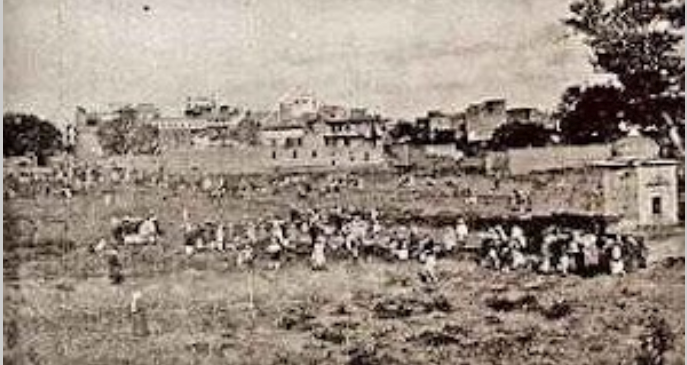
In 1927, the British government in India launched the Simon Commission, which consisted solely of British members that refused to accept Indian demands for self-governance.
This insulted several Indian parties fighting for swaraj such as the Hindu Mahasabha, the Muslim League, and the INC.
The commission was almost unanimously boycotted with the slogans, “Simon Go Back” and “Simon Wapas Jao”.
Purna Swaraj Resolution (1928–29)
In 1928, in response to the Simon Commission, multiple Indian political parties assembled at the All Parties Conference to frame the Nehru Report...
Quit India Movement a.k.a the Bharat Chhodo Andolan (1942–43)
When World War Two broke out in 1939, the British declared two things: that, number one, they were at war with Germany; and number two, so was India– without consulting the Indians, of course.
This decision was opposed by multiple Indian leaders as they believed the British forcing their subjects to fight their wars for them was unjust. Almost 3 million Indians had fought for the British up till now, though most of them had volunteered.
In comes Sir Stafford Cripps, a British official, with an offer for Indians to prevent more unrest in the war years to follow. The Cripps Offer promised India dominion status and more freedoms later if they cooperated with the British in the war.
Furthermore, they promised an “opt-out” policy for any states that did not want to join a united India. This pleased Mohammed Jinnah, the leader of the All-India Muslim League, as he desired the creation of a separate Muslim state called Pakistan. However, this angered Gandhi, who wanted nothing to do with a divided India.
Despite clear Indian demands to keep their country out of WWII, the British ignored them. Gandhi exclaimed, “Leave India to God. If that is too much, leave her to anarchy.”
In 1942, the INC passed the Quit India resolution, demanding the British leave India or face another non-violent movement led by Gandhi. He delivered his famous “Do or Die” speech.
“The mantra is ‘Do or Die’. We shall either free India or die in the attempt; we shall not live to see the perpetuation of our slavery.” – Mahatma Gandhi, 1942.
Several figures including Dr. B.R. Ambedkar and Mohammed Jinnah opposed the movement, fearing INC dominance would marginalize Dalits and Muslims.
The British responded by arresting leaders without trial and censoring the press. This backfired, leading younger activists to adopt more aggressive tactics while underground press flourished.
Nonviolent actions included strikes and marches, while violent actions included sabotage of British infrastructure.
The British retaliated with bombings, mass arrests, and military force. Despite failing to achieve independence immediately, the movement gained international sympathy.
The Muslim League expanded rapidly and strengthened its demand for a separate Muslim state, influencing the eventual Partition of India.
Bose and India in World War II (and an unexpected crossover?)
During WWII, Subhas Chandra Bose rose to prominence. Rejecting Gandhi’s nonviolence, Bose believed freedom required armed struggle.
He became leader of the Indian National Army (Azad Hind Fauj) in 1943, composed largely of Indian POWs and veterans.
Bose escaped house arrest, reached Nazi Germany, and sought help from Adolf Hitler and Benito Mussolini under the logic of “the enemy of my enemy is my friend.”
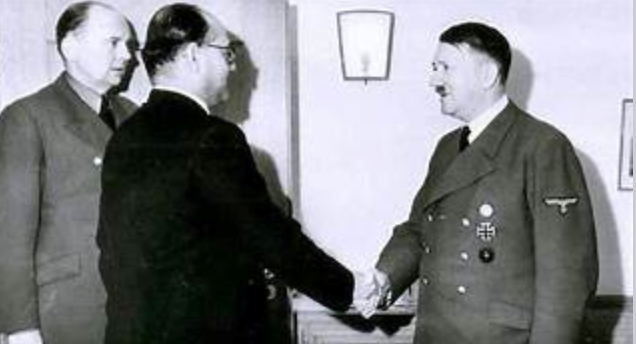
This is a real photo btw, Mussolini (left), Bose (centre), Hitler (right)
Germany declined major support, so Bose turned to Japan. With Japanese assistance, the INA captured the Andaman and Nicobar Islands.
Bose formed a provisional government of independent India in 1943 and created the Rani Jhansi Regiment, a women’s unit led by Captain Lakshmi Swaminathan.
Attempts to re-enter India failed, and Bose died in a plane crash.
Indian Independence (1947)
After decades of struggle, India gained independence on August 15th, 1947, with Jawaharlal Nehru as its first Prime Minister.
Unit 2: Industry and Labour
Case Study – Industrial Revolution (Britain / USA / Japan)
Statement of Inquiry
Key Concept: Change
Related Concepts: Conflict, Causality
Global Context: Scientific and Technical Innovation
Inquiry Questions
Factual
- Define change.
- Identify some major problems related to industrialization.
- In what ways can scientific advancements create challenges and opportunities?
Conceptual
- Explain how the Industrial Revolution enabled technological and societal change.
- Justify how industrialization altered social class structures.
Debatable
Do the benefits of revolutionary scientific and technical innovations outweigh their negative social and economic consequences?
Argument: Economic growth, job creation, mass production, improved living standards.
Counter-Argument: Exploitation, child labour, inequality, environmental degradation.
The Origins of Farming
Agricultural practices emerged during the Neolithic Revolution, approximately 10,000–15,000 years ago.
Possible causes include warmer climates, advanced human cognition, religious rituals, and population pressures.
Farming led to permanent settlements, dietary changes, and the rise of pastoralism.
Pastoralism
Pastoralism, also known as herding, was an alternative lifestyle where individuals or groups would move around with large flocks of animals, like sheep, goats, or cows. This likely evolved in societies living in regions that weren’t conducive to agriculture, like deserts.
There were multiple benefits to this lifestyle, such as having a reliable source of food (milk, cheese, meat) as well as shelter and clothing materials (leather, bone, sinew, wool, fur). This also meant that they could trade with agricultural societies in exchange for goods each group lacked.
However, pastoralism had several downsides. Firstly, constant moving. With large herds, it was impossible to stay in one place as animals needed fresh grazing land. This prevented the formation of large permanent settlements.
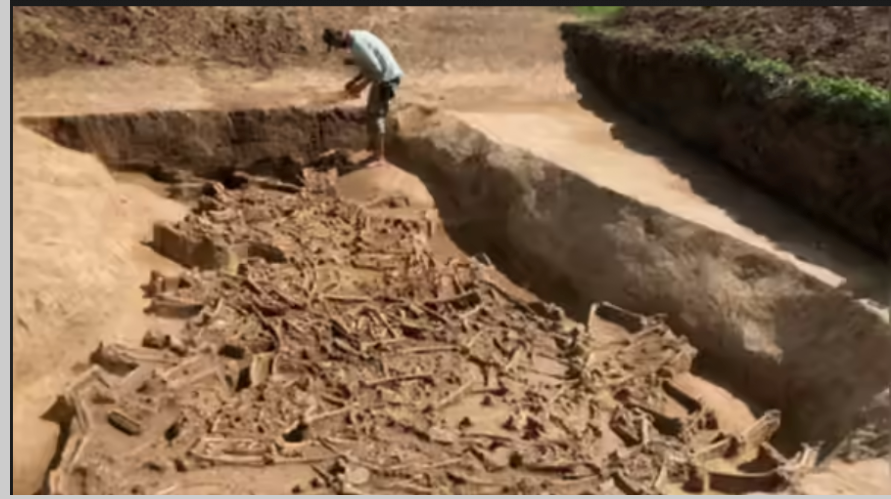
Secondly, overgrazing could deplete vegetation and erode soil. Thirdly, zoonotic diseases spread more easily between animals and humans. Finally, conflict arose between herders and agricultural societies, as shown by archaeological findings like the Talheim Death Pit.
Yep, those are all bones. Human bones. From multiple people. That’s the Talheim Death Pit.
The Impacts of Agriculture
Expansion into Industries Beyond Agriculture
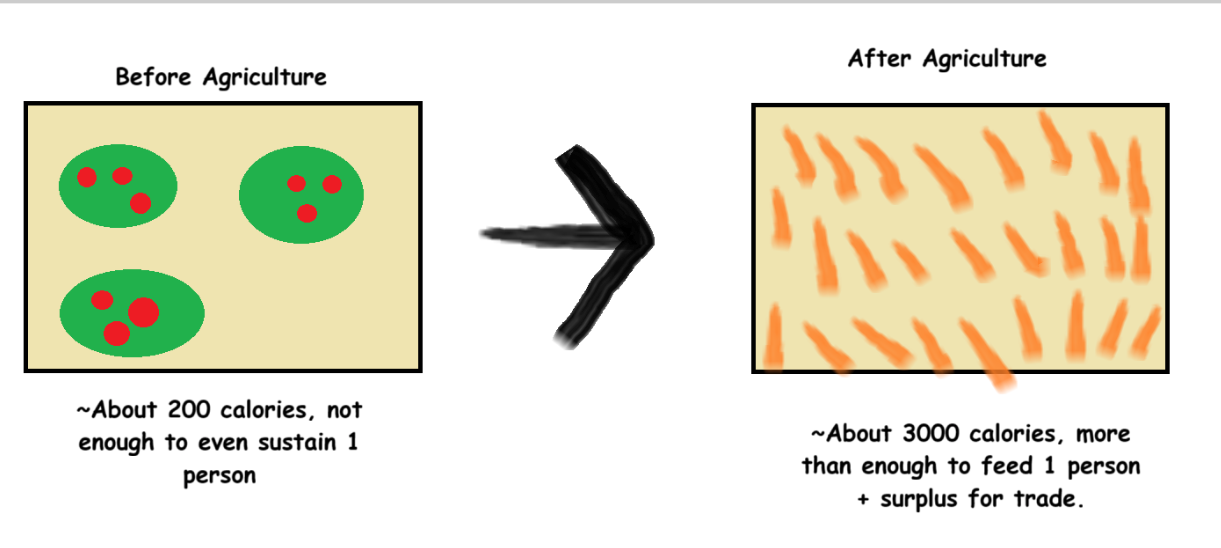
Prior to agriculture, hunter-gatherers needed to work constantly to sustain themselves. Agriculture introduced surplus food, allowing specialization into other trades such as toolmaking.
Better tools increased agricultural output, reinforcing the cycle of surplus and specialization.
Political Impacts
As populations grew, city-states formed systems of governance, taxation, defense, and writing, leading to governments and militaries.
Surplus food enabled trade between communities, leading to barter systems and eventually currency.
Technological Impacts
Agriculture offered a controllable and reliable food supply compared to hunting and foraging.
Negative Impacts
Environmental
Agriculture caused deforestation, slash-and-burn farming, soil infertility, and long-term environmental degradation.
Repeated planting depleted soil nutrients, reducing productivity.
Social
Farming was labor-intensive, leading societies to adopt slavery or later machinery to replace human labor.
Technological
Crop dependence made societies vulnerable to floods, droughts, and natural disasters.
Industrial Revolution: Barebones Notes
Causes
Political
Peaceful conditions, population growth, improved diets, and global trade allowed experimentation and innovation.
Social
Slave labour and the Enclosure Movement displaced farmers, pushing them into cities or factory work.
Economic
Demand for Indian textiles pushed British innovation in spinning and weaving technology.
Geographic
The Black Plague raised labor costs, encouraging mechanization. Britain’s coal reserves powered industrial machines.
Impacts of Industrialization
Economic
Industrial growth, higher wages, efficiency, and increased productivity.
Social
Child labour, exploitation of women, and replacement of workers by machines.
Political
Labour unions formed, new social classes emerged, and urban areas gained political power.
Technological
Advances in communication such as Morse code and the telegraph.
What Was the Industrial Revolution?
A period marked by increased production, scientific and technical innovation, mechanization, and new energy sources.
Inventions of the Industrial Revolution
The Cotton Gin
Inventor: Eli Whitney
Whitney developed the cotton gin to meet the soaring demand for cotton from British textile industries.
How It Worked
- Hopper
- Toothed Cylinder
- Breastwork
- Clearer
Impacts
Economic
U.S. cotton production dominated global markets; Whitney faced patent disputes.
Social
Slavery expanded, productivity increased, and U.S.–U.K. trade strengthened.
Political
Sectional tensions contributed to the American Civil War.
Technological
Interchangeable parts and transport innovations followed.
Environmental
Deforestation and soil depletion occurred.
Positive Impacts of Agriculture
Social
Increased nutrition availability due to higher calorie density per square kilometer.
Morse Code
Inventor
Samuel Morse.
Morse was an American inventor who attended Yale University and was a prolific painter.
He was fascinated by the study of electricity, and his invention of Morse Code and the
single-line telegram was spurred on by the discovery of electromagnetism.
He developed Morse Code alongside his close friend and partner Alfred Vail.
Why It Was Made
Morse code was invented to fulfill the need for rapid and efficient long-distance communication.
Existing systems such as the semaphore were simply too inefficient and inaccurate.
Furthermore, the increase in trans-national and international trade spurred the need for
long-distance communication even more.
How It Worked
The code itself was an arrangement of dots and dashes which are transmitted as flashing
lights or sounds that represent each letter of the alphabet.
Meanwhile, the receiver contained an electromagnet. Upon receiving an electrical signal
from the telegraph, the electromagnetic moved a stylus that made an imprint into a piece
of paper tape for the duration of the signal, and did not touch the paper if there was no signal.
In this way, lines and dots were made.
For example, . . . - - - . . . translates to SOS, or Save Our Souls.
Impacts
Economic
- Morse code helped the shipping industry communicate about seafaring conditions for the safer transport of goods internationally.
- It was also a cost-effective way to transmit information over long distances compared to existing alternatives.
Political
- It was used to send messages in WWII, the Korean War, and the Vietnam War.
- Morse code was also employed to encode messages for espionage operations during the Cold War.
Social
- It created jobs for telegraph operators and amateur radio operators (HAMs) in the military.
- To this day, it’s still used in certain emergency services communications.
- Finally, it improved global connectivity through long-distance communications.
Technological
- The telegraph inspired the development of the fax machine and the telephone later down the line.
The Spinning Jenny
Inventor
James Hargreaves
Why It Was Invented
Hargreaves lived close to the English town of Blackburn, which was famous for its
“Blackburn greys”, which were cotton-linen blend fabrics imported from India.
However, the demand from the textile industry grew in Britain, and previous inventions
such as John Kay’s flying shuttle improved the productivity of weavers, which put
additional pressure on spinners of cloth to up their game…
How It Worked
The spinning jenny works by allowing one person to spin multiple threads at once (initially eight, later many more) using a hand wheel, a set of spindles, and movable bars to draw out fibers. A spinner attaches rovings (loosely twisted fibers) to spindles, pulls a handle to extend the fibers, and then turns the wheel, which spins all threads simultaneously before they are wound onto the spindles.
Impacts
- New Jobs: Created factory jobs, though often low-skilled, for women and children.
- Market Growth: Enabled mass production, driving economic growth and expanding the textile industry.
- Job Displacement & Unrest: Threatened the livelihoods of skilled hand-spinners, causing social disruption and resistance.
- Harsh Working Conditions: Factory workers often faced long hours, low wages, and poor living conditions in slums.
- Catalyst for Innovation: Spurred further inventions like the Water Frame and Steam Engine, accelerating mechanization.
- Textile Revolution: Transformed cotton and wool industries, establishing the foundation for modern industrial practices.
The Water Frame
Inventor
Richard Arkwright
Why It Was Invented
The water frame was invented by Richard Arkwright in 1769 to meet the growing demand for cotton yarn by mechanizing spinning: There was a massive, increasing demand for cotton cloth that existing methods couldn't satisfy. Early machines like the Spinning Jenny produced weaker thread, but the Water Frame was designed to create stronger, more durable yarn suitable for warp (lengthwise threads).
Innovations of the water wheel:
Water Power: It used a water wheel, making it one of the first power-driven textile machines, allowing for continuous operation and higher output.
Roller System: Four sets of rollers drew out the cotton, with one set moving faster than the other, producing a finer yarn that was then twisted by spindles.
Factory System: Its size and power requirements led to the establishment of factories located near water sources, centralizing production and ushering in the modern factory system.
Impacts
- Economic Growth: Boosted textile industry efficiency, reduced labor costs, and stimulated economic expansion through increased exports.
- Urbanization: People migrated to factory towns for work, leading to the growth of cities and new social structures.
- New Labor Demands: Transformed work into long, repetitive shifts in harsh factory environments (dusty, noisy), creating a distinct working class.
- Foundation for Further Innovation: Its success spurred further mechanization, like the power loom, and the development of related machinery, like powered carding engines.
- Increased Output: It automated spinning, allowing for continuous, faster, and much larger production of strong cotton yarn, essential for warp threads.
The Flying Shuttle
Inventor
John Kay, patented in 1733.
Why It Was Invented
The flying shuttle was designed to dramatically speed up the weaving process and allow for wider fabrics to be woven by a single person, overcoming the bottleneck where spinning couldn't keep up with hand weavers, thus fueling the Industrial Revolution's textile boom. Before this, wide cloths required two weavers passing the shuttle manually
How It Worked
It worked by using a cord and paddles to rapidly shoot the shuttle carrying the weft thread across the loom's warp threads, allowing a single weaver to create wider fabrics much faster than manually passing the shuttle. A weaver would press a foot pedal to create an opening (shed) in the warp, jerk a cord to send the shuttle flying through, then change the pedal, and jerk the cord back to return the shuttle
Impacts
- Increased Weaving Speed & Output: The shuttle's automated movement allowed a single weaver to produce cloth much faster, effectively doubling output and reducing labor intensity.
- Wider Fabrics: It enabled weavers to create much wider fabrics, previously requiring multiple workers, with just one operator.
- Increased Demand for Raw Materials: Higher output increased demand for cotton, intensifying colonization (e.g., in India) and reliance on slave labor (e.g., in American colonies) to supply raw materials.
- Wider Fabrics: It enabled weavers to create much wider fabrics, previously requiring multiple workers, with just one operator.
- Labor & Social Shifts: It transformed weavers from skilled craftsmen to machine operators, altering work patterns and contributing to broader social changes like urbanization.
The Wright Flyer
Inventor
Brothers Orville and Wilbur Wright, alongside mechanic Charles E. Taylor.
Why It Was Made
The Wright Flyer was just one of many inventions produced in humanity’s historical attempts
to conquer the skies. However, it belonged to the “heavier-than-air” class of machines.
As the name suggested, it was heavier than the surrounding air but still managed to stay
afloat in the sky.
How It Worked
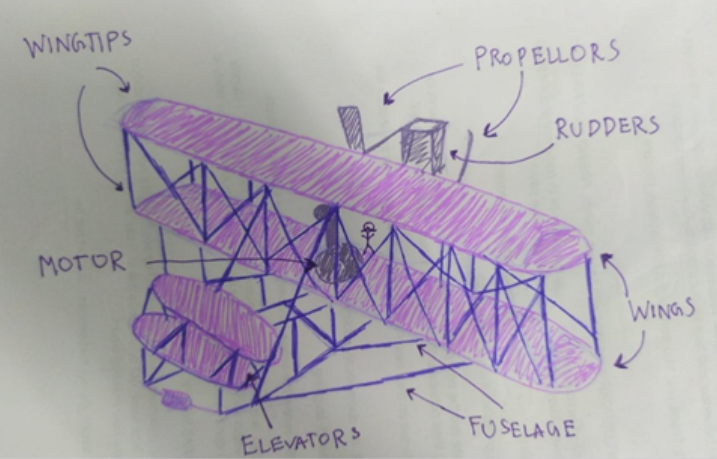
What made the Wright Flyer unlike other flying machines designed at the time was its wing control,
allowing the pilot to tilt the angles of the wingtips at opposite angles to control the horizontal
motion, or “roll”, of the plane.
Furthermore, manually-controlled rudders enabled the pilot to control the diagonal motion,
or “yaw” of the plane. The brothers made their first flight in Kitty Hawk, North Carolina in
the U.S., for 6.4 km.
Impacts
Technological
- Aeronautics: The process through which the Wright Brothers tested their plane, including the usage of a wind tunnel, inspired modern-day aeronautical science.
Political
- Military: The U.S. military purchased models of their planes for World War I to build the backbone of the early American Air Force.
Evolution into Modern-Day Invention
Later inventors used jet engines in place of the four-cylinder engine that the brothers had used,
which used the heated, high-velocity gas ejected during the combustion of fuel to produce thrust
for aircrafts.
These jet engines travelled at supersonic speeds and even enabled pilots to break the sound barrier.
After the end of World War II, though, the aviation industry began to move towards a more commercial
angle and opened up commercial passenger flights, birthing companies like Boeing.
The Watt Steam Engine
Inventor
James Watt
Why It Was Invented
Created in 1776, its sole purpose was to pump water out of coal mines. However, additional
adjustments gave it rotational motion that enabled it to turn wheels, allowing it to power
early steam engines as well.
Coal mining was a lucrative industry at the time, with Britain having large supplies of coal
close to the surface, encouraging them to switch to using it as a primary fuel source throughout
the Industrial Revolution.
The steam engine as a whole was initially designed by Thomas Newcomen in 1712 to pump water out
of coal mines, which would often flood from groundwater. It was later refined upon by Watt to
create the Watt steam engine.
How It Worked
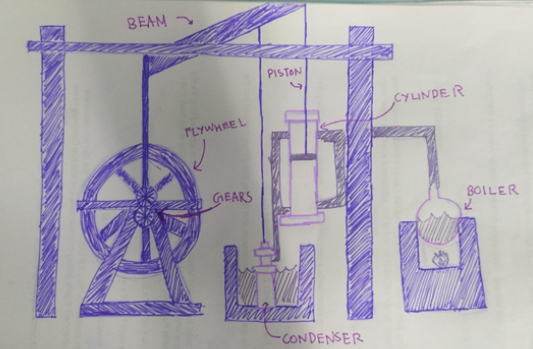
In principle, the engine converted linear motion from the piston to rotational motion on the flywheel.
The piston itself was powered by hot expanding steam, which was cooled in a separated condenser
to reduce the atmospheric pressure and make the piston drop and rise repeatedly.
Watt later added gears to facilitate smoother rotary motion of the wheel, which led to the engine
being utilized to power steam locomotives.
The Daguerreotype
Inventor
Louis Daguerre
Why It Was Invented
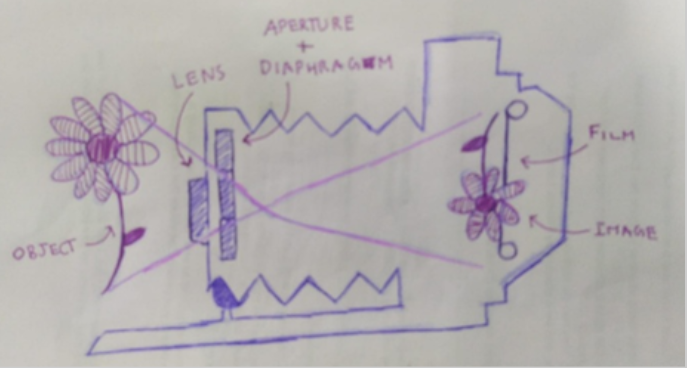
The device fulfilled the historical need for capturing images permanently, and was built
upon existing machines such as the camera obscura, which had existed since the Renaissance
and projected outside images on a smaller screen for artists to trace.
How It Worked
The Daguerreotype was a type of early camera that produced permanent, high-resolution photos,
invented by Louis Daguerre in the 1830s.
The camera contained a small copper plate that worked as the “film”, which was coated with
silver iodide, a chemical that was light-sensitive and darkened when exposed to large amounts
of light.
When exposed to an object in light via the opening of the camera called the aperture, select
parts on the film would darken, forming an inverted image of the object on the film.
The plate would then be removed from the camera manually and quickly soaked in hot salt
solution to prevent the image from darkening further, and a permanent photo, called a
“Daguerreotype”, was created.
Evolution into Modern-Day Invention
The process utilized costly copper plates, meaning it was soon replaced by the wet collodion
process that was inspired by the Daguerreotype’s method, but printed images on glass, which
was cheaper.
The wet collodion process itself was supplanted by the dirt-cheap and revolutionary Kodak
Brownie film camera, which utilized a thin type of paper film coated with silver iodide to
produce up to 100 small photos, though each camera was sold for just $1 at the time.
Finally, the Daguerreotype would eventually go on to inspire the modern DSLR camera.
Similar to its ancestor, the DSLR camera also allows light to enter through an aperture
which can be adjusted.
However, when sufficient light has been exposed, rather than removing the plate manually,
small curtains in the camera called “shutters” close, blocking additional light rays.
The light rays themselves pass through a light sensor, which contains miniature red, green,
and blue sections called “pixels” that are sensitive to those colours, and store electric
charge depending on the intensity of the light rays of their corresponding colour.
Areas with more intense electric charge produce more vibrant colours, similar to how the
silver iodide-coated plate was sensitive to varying intensities of light. The pixels are
finally read by the camera to produce an image.
Impacts of the Industrial Revolution
Political
Initial increase in demand for slave labour: Slaves were needed to not only take over food
production as people shifted away from farming and moved towards other jobs, but also to
harvest palm oil and other fuel sources to keep machines running.
Finally, from a political perspective, the Industrial Revolution was a peaceful and cooperative
period in human history. Firstly, the economic development as a result of the revolution
reduced societal divides.
The proletariat formed mutual-aid societies to assist one-another in times of need; whereas
the bourgeoisie formed philanthropic organizations and charities to support public works both
out of goodwill and to showcase their wealth.
However, the revolution also led to the formation of the opposing ideas of capitalism,
Marxism, and socialism, as well as the separation of the middle class into the bourgeoisie
and the proletariat which was made more evident due to the division of labour and the nature
of work performed by each class.
Families were separated, especially in factory work, to earn more money compared to joint
work on farmland previously. Thus, the Industrial Revolution both created massive societal
divides across social classes, but also bridged gaps between various groups as well.
International trade fostered amiable relationships between countries. The development of
the steamboat with solid iron hulls improved overseas trade, while Britain relied on the
U.S. and India for raw cotton.
By 1900, 30% of Britain’s income came from trade compared to just 8% in 1700.
The construction of the Suez Canal by 1869 further facilitated trade.
On the other hand, the Industrial Revolution perpetuated slavery and reinforced colonial
attitudes. Colonies were forced to produce raw materials under the threat of military action,
while mass-produced British goods outcompeted local artisans.
Labour unions formed significant political movements, such as the German Social Democratic
Party and British reform groups advocating for secret ballots and fair parliamentary
representation.
The Reform Bill of 1832 improved representation for industrial cities but failed to give a
voice to the working classes.
Economic
Division of labour allowed individuals to specialize in specific professions, improving
productivity as settlements urbanized.
New jobs emerged in transport, metallurgy, healthcare, engineering, and housing, while
mechanization also caused widespread unemployment in traditional manual labour roles.
Interchangeable parts improved efficiency, though strikes, disease outbreaks, and poor
working conditions limited productivity gains.
New industries such as mining, steel production, rail transport, and overseas trade formed
interconnected economic systems, while also perpetuating exploitative institutions such
as slavery.
Social
Urbanization improved infrastructure and public health, leading to increased life expectancy
and scientific breakthroughs in medicine.
However, factory conditions and poor housing led to disease outbreaks, environmental
contamination, and severe health issues among the working poor.
Gender Equality
Increased demand for labour brought more women into the workforce, contributing to the
women’s suffrage movement.
Despite progress, women faced exploitation, wage inequality, and social abuse, reinforcing
systemic gender disparities.
Child Labour
Children were widely employed due to low labour costs and lack of compulsory education,
leading to dangerous working conditions and high accident rates.
Education reforms eventually reduced child labour after its dangers were recognized by
governments.
Rise of New Social Classes
Okay, hang on, this one needs a whole new subsection so:
The Rise of the Bourgeoisie and the Proletariat
(and the Foundations of Marxism)
Capitalism
The capitalism of the Industrial Revolution, a.k.a, industrial capitalism, is very different
from the longstanding mercantile capitalism that existed in the world previously.
Whereas mercantile capitalism only affected traders and merchants, industrial capitalism
would go on to change the lives of almost everyone.
Industrial capitalism can be defined as an economic system that relies on investment of
capital in machines and technology that are used to increase production of marketable goods.
For example, investing in the cotton gin to process raw cotton faster than slave labour could
be considered a form of industrial capitalism.
Origins of Industrial Capitalism
-
English Civil War: The chaos and unrest of the war prevented the monarchy
from enforcing trade restrictions, enabling free trade and the growth of capitalism.
-
Agricultural Productivity: The British Agricultural Revolution increased
crop yields, population growth, demand, and prices. Farmers invested in new technologies,
creating a positive feedback loop of production and profit.
-
High Wages: Britain paid the highest wages in the world at the time, while
necessities remained cheap. This increased demand for consumer goods and incentivized
manufacturers to invest in machinery.
-
Enclosure Movement: Common land was privatized by landlords and investors,
signaling a shift toward capitalist ownership and profit-driven land use.
-
Publicization by Authors: Writers such as Thomas Mun promoted the idea that
markets controlled the economy and that participation in them was human nature.
Impacts of Industrial Capitalism in Agriculture
-
Fewer people working in agriculture: In 1520, 80% of Britain’s population
worked in farming. By 1800, only 36% of male laborers did, and by 1850 this dropped to 25%.
-
Obesity versus starvation: In wealthy nations, surplus food and disposable
income led to obesity replacing starvation as a leading health issue.
-
Loss of jobs: Farmers displaced by the Enclosure Movement lost their
agricultural livelihoods.
Socialism
Socialism evolved as a response and protest against the outcomes of capitalism such as
poverty, poor living conditions, child labour, and exploitation.
This conflict led to a clearly defined class struggle and the emergence of two distinct
social groups: the proletariat and the bourgeoisie.
The Bourgeoisie
The bourgeoisie owned the means of production, including factories, land, and capital.
They enjoyed higher living standards, better education, healthcare, and housing.
The Proletariat
The proletariat were the working class, owning only their labor, which they sold to survive.
They were often exploited and lacked access to basic resources and services.
The loss of cottage industries and communal land ownership reinforced this divide, as former
farmers lost control of the means of production and became factory workers.
Class Struggle and Marxism
The unequal power balance between the bourgeoisie and the proletariat led to frequent class
conflict. This aligns with Karl Marx’s key idea that class struggle defines social classes.
Conflict forces classes to become self-aware of their position in society, while the absence
of conflict causes this awareness to fade.
Key Tenets of Marxist Ideology
- Production of goods gives life inherent meaning.
-
Humans are naturally social creatures, and collective cooperation is more efficient than
isolated private competition.
Through his ideology, Marx aimed to empower the proletariat to resist exploitation by the
bourgeoisie.
The poor man had no idea about Stalin or Mao. He didn’t know what was coming, did he?
Unit 3: Rights and Social Protest
(US Civil Rights Movement · African Anti-Apartheid Movement · Black Lives Matter)
Nelson Mandela
Born Rolihlahla Mandela in 1918, Mandela was nicknamed “Nelson” by one of his teachers.
He studied law and became a lawyer in 1942.
In 1944, he joined the African National Congress (ANC). Alongside Oliver Tambo, another Black man…
Apartheid in South Africa
Background
European colonization of Africa intensified during the late 1800s in the “Scramble for Africa.”
The Dutch established settlements in South Africa in 1652, later overtaken by the British in 1815.
Indigenous Black South Africans were forced into exploitative labor roles under white control.
The Creation of Apartheid
In 1948, the South African government introduced apartheid, a system of laws enforcing racial
segregation across housing, education, marriage, recreation, and political participation.
Housing
The 1913 Natives Land Act restricted Black South Africans to designated reserves, forcing
70% of the population onto just 13% of the land.
“Awakening on Friday morning, June 20, 1913, the South African Native found himself,
not actually a slave, but a pariah in the land of his birth.”
— Sol Plaatje
Communal land ownership stripped Black South Africans of economic power and forced them into
exploitative labor arrangements.
Education
In 1974, Afrikaans was imposed as a language of instruction, creating barriers to education.
Mixed-race universities were banned.
Marriage
Interracial marriages were banned.
Recreational Activities
Public recreational spaces were segregated by race.
Political Activities
Black South Africans were denied the right to vote under apartheid.
Employment
Following the initiation of apartheid, Black workers were considered temporary
“visitors” in white-owned areas, and their trade unions were not recognized,
subjecting them to more exploitation.
The Fight Against Apartheid
The struggle against apartheid was spearheaded by three main political groups:
the Communist Party (legally banned in 1950), the African National Congress (ANC),
and the Pan-Africanist Congress (PAC), which splintered off from the ANC.
As the Cold War intensified during the 1960s and 1970s, the South African
government used the presence of the Communist Party as justification to suppress
resistance movements.
In 1963, Nelson Mandela and other activists were tried for “advancing communism.”
Many were imprisoned for life or forced into exile.
Key Figures in Rights and Social Protest
Martin Luther King Jr.
Rosa Parks
Other Influential Individuals
- Norman Rockwell: (my favorite American artist!)
- Rosetta Tharpe: (invented Rock n’ Roll)
- Ernie Barnes: (his art is gorgeous)
- Steve Biko:
Unit 4: Trade, Aid and Exchange
The European Union
The factors that led trade to encourage aid and exchange as well as bring
exploitation and tension.
The ways in which trade can foster both international cooperation and
international tension.
The formation and functioning of the European Union
Key Concept: Global Interactions
Related Concepts: Cooperation, Interdependence, Significance
Factors that led trade to encourage aid and exchange, as well as exploitation and tension
- Trade develops when countries specialize in producing goods and services based on comparative advantage, increasing global efficiency and economic growth.
- Increased trade creates wealth, enabling governments and international organizations to provide aid such as development funding, disaster relief, and infrastructure support.
- Trade networks promote cultural exchange, transfer of technology, and the spread of knowledge, strengthening global connections.
- Historical trade systems, such as colonial trade, often involved exploitation where powerful states extracted raw materials and labor from weaker regions.
- Unequal trade relationships can lead to economic dependency, where developing countries rely heavily on exporting low-value raw materials.
- Multinational corporations may exploit weak labor laws, leading to poor working conditions and environmental damage.
- Competition for resources, strategic trade routes, and markets can create political rivalries and international tension.
- Economic inequalities created by trade can increase social unrest and resistance within and between countries.
The ways in which trade can foster both international cooperation and international tension
- Trade encourages cooperation through international trade agreements that reduce tariffs, quotas, and other barriers.
- Economic interdependence makes conflict less likely, as countries rely on one another for economic stability.
- Shared economic interests promote diplomacy and collaboration through organizations such as the World Trade Organization (WTO).
- Trade partnerships can strengthen political alliances and regional integration.
- Tension arises when countries protect domestic industries through tariffs, subsidies, or import bans.
- Trade imbalances may cause disputes, particularly when one country exports significantly more than it imports.
- Sanctions and trade restrictions can be used as political tools, increasing hostility between states.
- Disagreements over labor rights, environmental standards, and intellectual property can strain international relations.
The formation and functioning of the European Union
- The European Union was formed to prevent future conflict in Europe following World War II by increasing cooperation and interdependence.
- It originated from the European Coal and Steel Community (1951), which linked key war industries under shared control.
- The Treaty of Rome (1957) established the European Economic Community (EEC), promoting economic integration.
- The Maastricht Treaty (1992) formally created the European Union and expanded cooperation beyond economics.
- The EU operates as both an economic and political union of member states.
- The single market allows free movement of goods, services, capital, and people.
- Some member states use a common currency, the euro, to simplify trade and financial stability.
- The European Commission proposes laws and ensures treaties are followed.
- The European Parliament represents EU citizens and participates in law-making.
- The European Council sets overall political direction and priorities.
- The EU promotes regional development by supporting less-developed regions through funding.
- Challenges include differing national interests, economic inequality between states, and debates over sovereignty.