English
Unit 1: Descriptive writing, Narrative writing, Monologue writing, Dialogue writing, Script writing and screenplay.
Unit 3: Unit based on the Global Context. Producing non-literary text based on the Global context (scientific and technical innovation) – Persuasive writing.
Text Type: Speech Writing, editorials, Newspaper columns, Letters, Blogs, Proposal (Production of NonLiterary Texts)
Blog, Speech, Podcast, Proposal, Opinion column/ Editorial, Interview, Review, Webpage content, Manifesto writing, Letters, Journal/ Diary.
Compare and Contrast (Task 1)
Use this resource to practice: https://sites.google.com/view/findingmeaning/myp-language-and-literature/eassessment/task-1-analysing-texts/compare-and-contrast
This is an especially good exemplar! https://www.studocu.com/row/document/mpesa-foundation-academy/biology/compare-and-contrast-samples/98464469
In this task, two sources will be compared, such as a text and a video, a video and a poem, a poem and an advertisement.
!!Look for keywords! For example, if you have to see how two sources deal with the theme of resilience, the keyword is “resilience”. Then, based on the keywords, rewrite the question in your own words.
You can write similarities and differences in any order, but it’s recommended to do similarities first before differences.
Write down the short questions and points that occur to you when reading the question and the sources on the first pass.
Alternatively, you could do the similarity and difference between both sources for each section – a similarity and difference for purpose, a similarity and difference for audience, and so on.
Sample Response
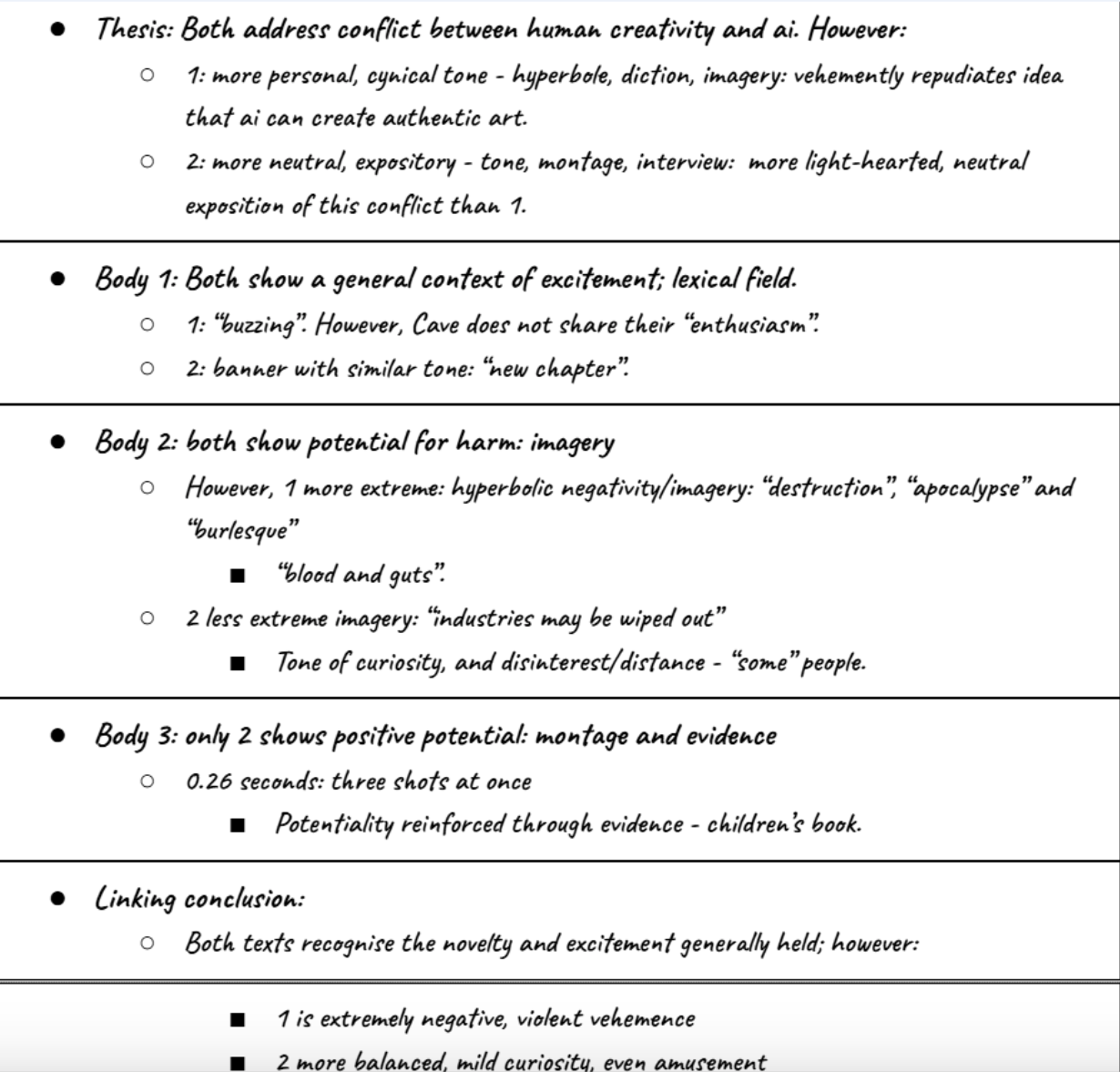
Format:
Introduction (3 sentences minimum):
- Hook/Intro.
- Introduce/summarize source A.
- Introduce/summarize source B.
- Connect the thematic similarities between both texts like their purpose.
- Thesis statement: Key points from the prompt/purpose (how do the sources present X concept?) + Point of similarity + Point of difference. (Mention PAFT through this).
!!Use transition words between paragraphs! (Similarly, conversely, etc.)
Follow this format for each paragraph of PAFT
Source A:
Point:
write your point here!Evidence:
Evidence your point with quotes from the textExplain:
Explain somethingEvidence:
Evidence the explanationExplain:
Explain somethingLink:
Link the expplanation to something in the textConclusion
Restate/paraphrase the thesis statement.
Summarize how the points proposed in the paragraphs were supported by evidence.
Conclude with an insight into the similarity/difference between the sources or the content of the sources and their purpose overall.
Analyze both sources utilizing PAFT from the lens of the prompt given in the question. For example, if the question asks how both sources “explore the impact of human activities on nature”, consider the Purpose, Form, and Tone of each source from the point of view of that prompt.
In case the source is a video, here are some visual techniques you can analyse:
Coloration: The use of certain colours or gradients can draw the eye to some areas or deliberately mask others. Colours also carry their own symbolic meaning.
Framing: How a subject is framed can convey how they are perceived and imply the filmmaker’s intention.
Symbolism.
Vectors: The paths that a viewer’s eye follows when viewing a scene or frame. This can be influenced by the framing or orientation of the camera, and can emphasize certain subjects over others.
Orientation and P.O.V.: Is the camera looking down on the subject? Looking up at them? At eye level? Are we looking through someone else’s perspective or from a third person perspective?
If the source is a poem, you can incorporate the FLIRT poem analysis strategy into PAFT like so:
Purpose: Themes and Form (the “F” and “T”); i.e., the purpose of the poem is determined by the themes it explores, and how does the form contribute to this?
Audience: Language (the “L”); i.e., what sort of audience is the poem’s language intended for?
Form: Imagery (the “I”); i.e., what kind of imagery is used in the poem and why? (Rhyme and repetition and language may also come in here).
Tone: Rhyme and repetition (the “R”); i.e., how does the rhyme scheme in the poem influence the tone?
Creative Writing (Task 2)
This will be story writing, screenplay, script writing, monologue, etc.
Focus on the story and fictional elements.
Story Writing: Key Scenes
Consists of problem buildup and climax, the most important scene of the story. The word “key scene” here refers to the climax of the story, and when writing it, start from the rising action with a little heed to the exposition.
The climax usually has a conflict that was introduced and has been building since the inciting incident. It can be an external conflict (ex:- a boy trying to kill a dragon to save his village) or internal (ex:- the same boy trying to overcome his cowardice and become brave by fighting off a dragon).
Unless it specifically asks for you to talk about the exposition, start your story as close to the end as possible. Try and jump into the action, or the meat of the story, as quickly as possible.
You can add background info through flashbacks, details, or character thoughts.
Exposition
Mention character and setting descriptions.
For character descriptions, use Look, Like, Feel, Do: What does the character look like? What do they like? How are they feeling? What are they doing?
For setting descriptions, use 5 Senses: Describe the scenery with respect to sight, sound, touch, taste, and smell. Mention the scenery, the weather, the time of day, and location, using an appropriate tone.
Even the same setting described in different tones can set the mood for two very different stories.
Take this setting, for an example:
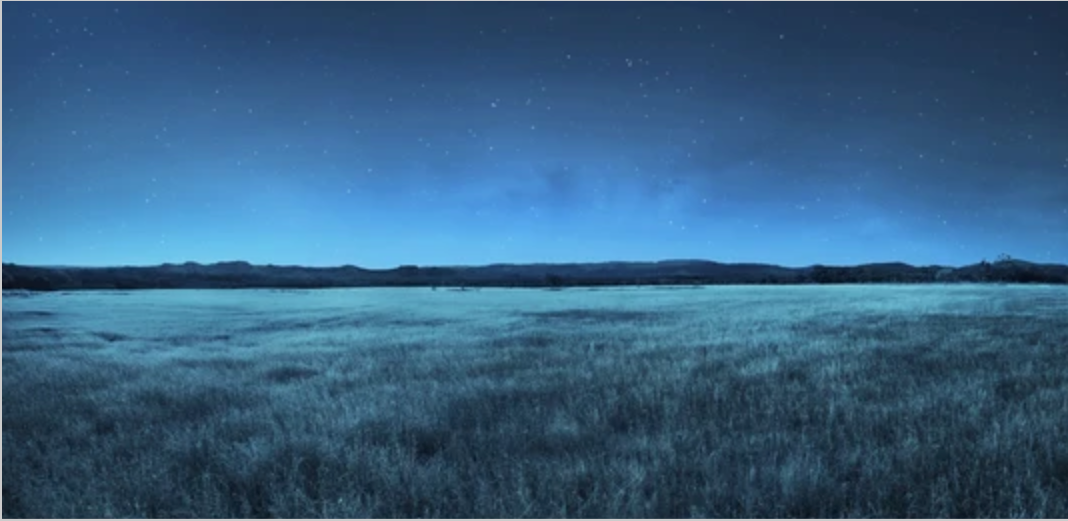
“A moody, moonless night with a strong breeze. The grasses were soft and silent witnesses to the forbidden rendezvous between the lovers.” → THIS sounds like the opening to a romance novel.
“An eerie, moonless night with a howling breeze. The grasses rustled unsettlingly, as though something lurked within them, hiding.” → THIS sounds like the opening to a horror story.
But they’re both describing the same setting!
Prose is a fictional text other than poetry, and lacks a metrical structure, so no iambic meter or iambic pentameter, and no rhyme scheme.
Poetry has metrical structure, despite being fictional as well.
Non-fiction Writing Based on Global Context (Task 3)
Focus on whatever aspects of the writing or piece that relate to the global context.
Scene Analysis
Setting:
Authentic, real setting, usually in a documentary, or fictional, artificial setting, usually in fiction?
Location and time period?
Use of colour in the scene?
Camera:
Location of camera in the scene/viewpoint of camera in the scene? Is it moving?
What effect does the positioning or movement of the camera like this have?
Objects:
What elements are visible in the scene?
Does the camera focus on some objects more than others?
How does the arrangement or combination of all objects in the scene affect the scene?
Characters:
Which characters are in this scene?
Briefly describe their role in the scene?
Mood:
What is the general mood of the scene?
How do all the earlier elements contribute to the mood?
What emotion does the director hope convey through this mood? Are they successful?
Conclusion:
What elements would you remove from the scene? Why?
Blog Format
Anecdotes: Personal experiences or memories that are relevant to the piece. Adds a personal touch.
Appealing Title and Byline: Something catchy, but not clickbaity. Think “Young British Girl Discovers Ancient Sword in Creek” versus “A New King Arthur Has Arisen!”
Personal Opinion: Exactly what it says on the tin (unless you’re like me and scared to have any opinions, let alone express them).
Justifications: Add points to back up your thoughts!
Factual Context: Add stats and numbers, all the good stuff.